
Changing the World One Interview at a Time
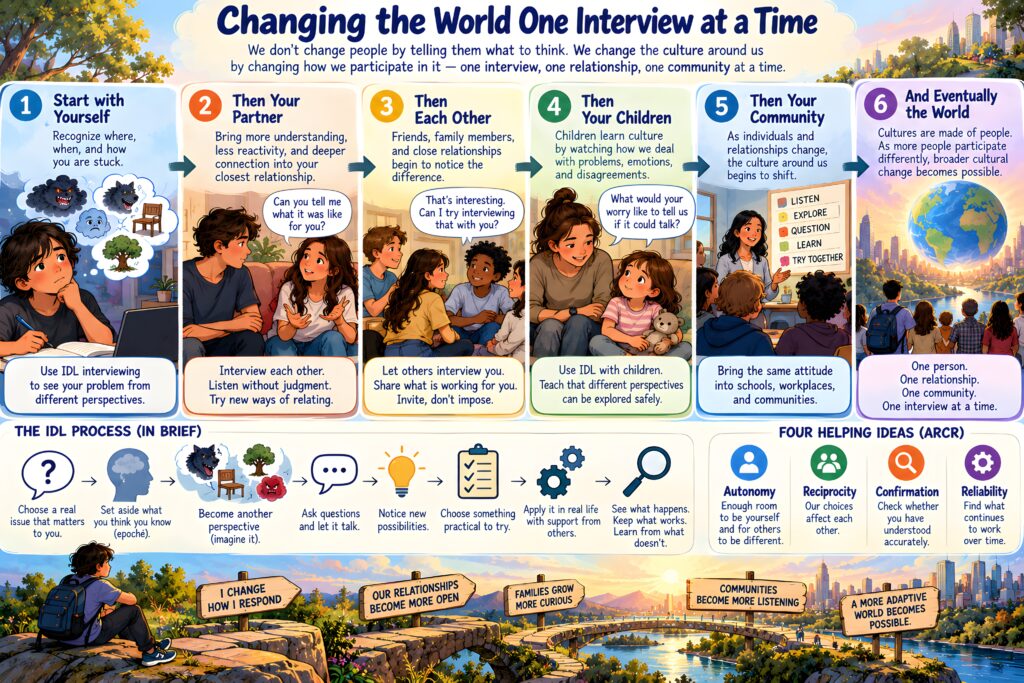
If you want to change the world, where do you begin?
With yourself.
Then with your partner.
Then with the people closest to you.
Then with your children.
Then, perhaps, with the larger communities and cultures in which you live.
This may sound much too small. The problems facing the world are enormous. What difference can one interview possibly make?
But cultures do not exist somewhere apart from people. Culture lives in the ways we think, the assumptions we make, the stories we tell, the ways we respond when we feel threatened, and the ways we treat one another. It lives around the dinner table, in marriages and friendships, in classrooms and workplaces, and in what children learn by watching adults.
If we want to change that culture, therefore, a reasonable place to begin is with the culture we ourselves create.
Begin With Yourself
Most of us are very good at seeing where other people are stuck.
We know what our partner needs to change. We can see the mistakes our children are making. We know why our friend keeps getting into the same kind of relationship or why our colleague creates the same problem over and over again.
Seeing where we are stuck is harder.
That requires some degree of objectivity.
Objectivity does not mean becoming completely detached from yourself or pretending that you have no feelings or preferences. It means developing enough distance from your normal way of seeing to recognize that your interpretation is an interpretation, your emotional reaction is a reaction, and your preferred solution is one possibility among others.
This is one reason IDL interviewing begins with perspective-taking.
When you temporarily experience a problem from the perspective of a dream character, an emotion, another person, or an imagined element of a situation, you loosen your identification with your normal point of view. You do not have to abandon it. You simply stop assuming that it is the only place from which the problem can be understood.
That can help you recognize where, when, and how you are stuck.
But recognizing that you are stuck is not enough.
You also need a way to get unstuck.
And, even more importantly, you need a way to notice when you are becoming stuck again.
Prove It to Yourself First
If IDL interviewing is useful, you should not have to believe that it works.
You should be able to find out.
Interview perspectives that emerge from your dreams and life issues. Listen to what they have to say. Notice whether they show you anything you had not already considered. Pay particular attention to recommendations that seem relevant and practical.
Then test them.
What happens when you actually apply them?
Do you respond differently during an argument?
Does a recurring fear become less powerful?
Do you recognize an assumption before automatically acting on it?
Do your relationships change?
Do recommendations continue to be useful after the excitement of the interview has disappeared?
If nothing changes, that matters.
If something changes, that matters too.
Before trying to convince anyone else of the value of IDL, give it the opportunity to prove—or fail to prove—its value in your own life.
Change your own culture before attempting to help someone else change theirs.
Let Other People Interview You
There is a simple way to begin spreading the process without becoming a teacher, preacher, therapist, or salesperson.
Ask someone else to interview you.
Give them the questions.
Explain that they do not have to interpret your answers, advise you, diagnose you, or figure out what your dream means. Their job is mostly to ask the questions, listen, and allow you to answer from the perspective you are interviewing.
Something interesting happens when you do this.
While they are interviewing you, they are learning how to interview.
They discover what it is like to listen without immediately offering advice. They see what happens when they do not impose their interpretation. They watch you move into another perspective, answer questions from it, return to yourself, and decide what—if anything—you want to do with what emerged.
You are not merely telling them how IDL works.
They are watching the process happen.
Ask Them to Help You Apply What You Learn
You can take the experiment one step further.
Suppose an interview gives you a recommendation that you believe is worth trying.
Tell someone close to you.
Perhaps your interview suggests that when you become defensive during disagreements, you should stop, repeat what you think the other person is saying, and ask whether you have understood correctly before responding.
Ask your partner to remind you.
Now something important has happened.
IDL has moved out of your imagination and into your relationship.
You have also made yourself accountable.
Instead of saying, “You need to communicate with me differently,” you are saying, “I am trying to change the way I communicate. Will you help me find out whether I actually do it?”
That changes the relationship.
You are no longer asking another person to accept a theory.
You are inviting them to observe an experiment.
Let People See What Happens
If IDL helps you become less defensive, less reactive, more curious, more capable of listening, or better able to recognize when you are trapped inside an assumption, the people around you will notice.
Not everyone will care.
Not everyone will want to try it.
That is fine.
IDL does not need to be imposed on anyone.
But some people may become curious.
They may ask:
“What are you doing differently?”
“Why didn’t you get angry just then?”
“What was that interview you did?”
“Could I try one?”
Now the invitation is coming from them.
That is very different from telling people that they need to change.
Then Interview Each Other
Eventually the process can become reciprocal.
You interview your partner.
Your partner interviews you.
Friends interview one another.
Parents interview children.
Children can sometimes interview parents.
People learn that listening does not require agreement and that understanding another perspective does not require surrendering their own.
Something subtle begins to change.
A relationship that previously consisted mainly of two people defending their own viewpoints begins developing additional places from which problems can be examined.
The culture of the relationship changes.
Then Our Children
Children learn culture long before anyone explains to them what culture is.
They learn it by watching us.
They notice how adults deal with anger.
They notice whether disagreement is dangerous.
They notice whether admitting a mistake brings humiliation or respect.
They notice whether adults really listen or merely wait for their turn to speak.
They notice whether power determines who is right.
Imagine instead a child growing up in a family where it is normal to say:
“I may be wrong.”
“Tell me what you think happened.”
“Let’s check whether I understood you.”
“Is there another way of looking at this?”
“What did you learn when you tried that?”
“I changed my mind.”
Those sentences teach something deeper than a technique.
They create a culture.
A child raised in such an environment is learning that identity can remain strong without becoming rigid, that disagreement does not have to become rejection, that different perspectives can be explored without automatically being believed, and that ideas ultimately have to meet experience.
From Personal Change to Cultural Change
This is how something as small as an interview can eventually become something much larger.
The sequence is not:
I know what is right → I teach you → you change → together we change the world.
It is closer to:
I examine myself → I experiment → I change what proves useful → you observe the difference → we experiment together → our relationship changes → the culture around our relationship changes.
From there the process can spread.
From yourself to your partner.
From partners to families.
From families to children.
From friends to communities.
From communities into schools, workplaces, helping professions, and other institutions.
There is no guarantee that it will.
There is no guarantee that every interview will be useful.
There is no guarantee that what works for you will work for someone else.
That uncertainty is part of the experiment.
But there is something you can do without waiting for governments, institutions, experts, or society as a whole to change first.
You can begin with the culture over which you have the most immediate influence:
your own.
Find where you are stuck.
Interview.
Listen.
Choose what seems worth testing.
Apply it.
Ask someone you trust to hold you accountable.
Notice what happens.
Let other people decide for themselves whether what they see is worth exploring.
Then, if they are interested, interview each other.
That is how IDL proposes changing the world—not by beginning with the world, but by changing the quality of participation within the relationships from which worlds are made.
One person.
One relationship.
One family.
One interview at a time.