
What does it take to change a life?
We often begin with a problem. A relationship has become painful. A familiar pattern keeps repeating. We feel anxious, directionless, or divided against ourselves. We want relief, and sometimes relief is exactly what we need.
But relief raises another question: What will keep us from recreating the conditions that made us suffer?
Beyond that lies a larger question: What might become possible if we learned to live from capacities we have barely begun to recognize?
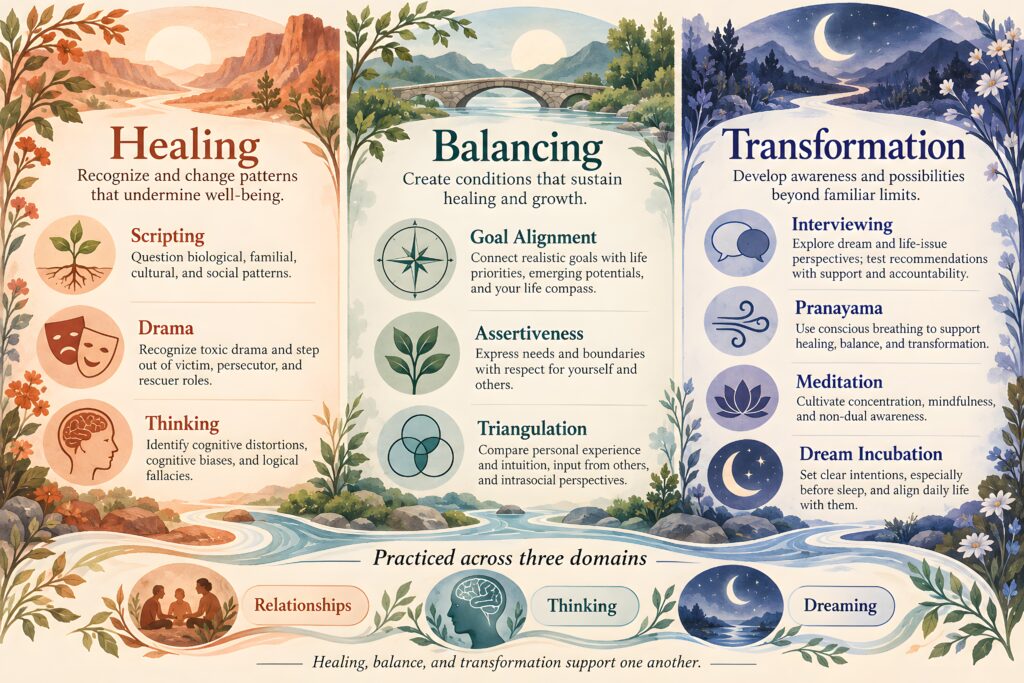
IDL approaches these questions through a curriculum organized around three interdependent processes: healing, balancing, and transformation.
Healing helps us recognize and interrupt patterns that undermine our lives. Balancing helps us establish the conditions in which healthier patterns can endure. Transformation opens us to perspectives and possibilities beyond our familiar sense of who we are.
These processes support one another. We may need greater balance before we can heal a persistent wound. A transformative insight may reveal something that still needs healing. Healing may release energy that allows us to pursue a more balanced life.
Throughout this curriculum, the work extends across three domains: relationships, thinking, and dreaming. These domains continually influence one another. What happens between people affects our inner conversations. Our inner conversations shape what we notice and how we respond. Our dreams may carry concerns, assumptions, and possibilities that waking life has overlooked.
Lasting change invites participation from all three.
Healing: Recognizing What Undercuts Our Lives
The healing component addresses scripting, drama, and thinking.
A script is a pattern that organizes experience. It tells us what to expect, how to behave, what we deserve, and what kind of person we are supposed to be. Some scripts help us navigate life. Others narrow our choices so quietly that we mistake their limitations for reality.
IDL examines four varieties of scripting: biological, familial, cultural, and social.
Biological scripting directs attention to the influence of our embodied needs and tendencies. Familial scripting includes the expectations and roles we acquire within our families. Cultural scripting carries larger stories about success, belonging, identity, and worth. Social scripting emerges through the groups, institutions, and everyday interactions that reinforce particular ways of living.
The task is to recognize when these influences become toxic—when they repeatedly undermine our well-being, relationships, or development.
Perhaps we learned that love must be earned through self-sacrifice. Perhaps we assume that disagreement threatens belonging. Perhaps we measure our worth against standards we never consciously chose.
Healing begins when these assumptions become visible enough to question.
We can then ask whether our scripts support our emerging potentials and our life compass: our developing sense of direction and what deserves our commitment. This inquiry belongs in relationships, where we enact familiar roles; in thinking, where we repeat inherited judgments; and in dreaming, where familiar patterns may appear in unexpected forms.
The second healing unit addresses drama.
Life inevitably contains conflict, uncertainty, disappointment, and strong emotion. Drama becomes toxic when our responses trap us in recurring patterns that intensify suffering and make constructive action harder.
The Drama Triangle offers one way to recognize such patterns through the roles of victim, persecutor, and rescuer. We may feel powerless, attack someone we blame, or take responsibility for solving another person’s life. We can also move quickly among these roles.
Stepping out of the triangle requires practice. We learn to recognize our participation, acknowledge what we feel, and choose responses that support responsibility and clear boundaries. Caring becomes more useful when it leaves room for another person’s agency. Accountability becomes more useful when it is specific enough to guide action.
This work also belongs within us. An inner critic can persecute. A helpless inner narrative can reinforce victimhood. Repeated attempts to suppress discomfort can resemble rescuing ourselves from experiences we need to understand.
The third healing unit concerns toxic thinking.
IDL examines cognitive distortions, cognitive biases, and logical fallacies. These overlap, but each directs attention to a different source of error: distorted interpretations, predictable tendencies in judgment, and weaknesses in reasoning.
We may turn one setback into a prediction of permanent failure. We may seek evidence that confirms our beliefs while overlooking evidence that challenges them. We may accept an argument because it appeals to fear, loyalty, or authority.
Recognizing these patterns matters when they arise spontaneously. It also matters when others deliberately exploit them. Weaponized toxic thinking uses vulnerabilities in judgment to capture attention, intensify division, or recruit allegiance.
The aim is greater discernment: enough awareness to examine a compelling message before surrendering our judgment to it.
Together, scripting, drama, and thinking ask us to investigate the patterns shaping our experience—and to stop treating every familiar pattern as trustworthy.
Balancing: Creating Conditions for Lasting Change
Healing can bring relief and understanding. Balance helps us carry those gains into ordinary life.
Insight alone may have little influence when our days remain organized around exhaustion, neglected relationships, competing demands, or goals we cannot realistically sustain. Balance creates room for change to become a way of living.
IDL develops this work through goal alignment, assertiveness, and triangulation.
Goal alignment begins by connecting long-term direction with near-term action. A five-year goal offers a horizon. A one-year goal brings that horizon closer. Six-month and one-month goals help translate intention into commitments we can evaluate.
Each time frame asks something different. Where do I hope to be going? What could I reasonably accomplish this year? What needs attention now? What will I actually do this month?
These questions apply across health maintenance, nutrition, exercise, communication skills, self-awareness, family, love, work, recreation, and learning.
The purpose is to notice how these areas support or undermine one another. A professional goal may depend on better sleep. A relationship goal may require stronger communication skills. A learning goal may become sustainable when it includes enjoyment.
This raises a particularly useful question: How can learning, work, and fun become more closely connected?
Curiosity can make effort exploratory. Thankfulness can help us recognize value within the life we already have. Functional non-duality invites us to investigate rigid divisions in experience, including the divisions we draw between productive activity and meaningful enjoyment.
Goal alignment also asks whether our ambitions fit our emerging potentials and life compass. Some goals deserve commitment. Others deserve revision once we recognize whose expectations they serve.
Assertiveness helps us act on that discernment.
Aggression pursues our needs in ways that disregard or override others. Passivity leaves our needs unexpressed or insufficiently protected. Assertiveness asks us to communicate clearly while recognizing the dignity and boundaries of everyone involved.
In relationships, this might mean making a direct request, naming a limit, or expressing disagreement without turning it into an attack.
Self-assertiveness brings the same clarity inward. We take our own observations, needs, and commitments seriously enough to act on them. We become more willing to question an internal demand that repeatedly pushes us beyond our limits.
IDL extends this inquiry into dreaming as well, asking how we might bring greater intention and agency to our responses within that domain.
The third balancing unit, triangulation, concerns better decisions.
IDL brings together three forms of feedback: personal experience and intuition, input from others, and intrasocial input—the perspectives encountered through its interviewing practices.
Each can reveal something the others miss.
Personal experience provides intimate knowledge, but familiarity can conceal blind spots. Other people offer observations we cannot easily make about ourselves, though their perspectives also have limits. Intrasocial input introduces additional viewpoints that may challenge the assumptions shared by our usual sources.
Triangulation asks us to bring these sources into conversation. Agreement can strengthen confidence. Disagreement can identify a question worth investigating.
Balance grows as we become more capable of using feedback without surrendering our responsibility to decide.
Transformation: Developing Beyond Familiar Limits
The transformation component includes interviewing, pranayama, meditation, and dream incubation.
It begins with a difficult question: Why do efforts to transform so often fail?
Sometimes an experience feels profound, yet our behavior changes very little. Sometimes confidence grows faster than competence. Sometimes we adopt an inspiring identity while leaving familiar patterns largely untouched.
IDL therefore asks us to distinguish authentic transformation from its appearances. Its attention to the Dunning–Kruger effect encourages examination of the gap that can arise between confidence and demonstrated ability.
Real confidence develops through engagement, feedback, testing, and correction. We become more capable of recognizing both what we know and what remains beyond our understanding.
Healing and balance support this process. They help us meet uncomfortable feedback and give new capacities a stable place in daily life.
Interviewing is central to this work.
Through interviewing dream elements and personified life issues, IDL invites us to explore perspectives beyond our habitual account of ourselves. The practice asks whether something we dismiss, fear, or misunderstand might offer a useful vantage point on a problem.
A dream figure may suggest a different relationship to uncertainty. A personified obstacle may frame a conflict in terms we had not considered. The value of such encounters lies partly in their capacity to reveal blind spots and generate practical possibilities.
IDL connects this inquiry with functional non-duality, evolutionary imperatives, and the development of ARCR. These are subjects for sustained exploration within the curriculum: how we grow, how we relate across apparent divisions, and which capacities support healing, balancing, and transformation.
Interviewing also generates reframing and recommendations. A new perspective can change the meaning of an experience; a recommendation proposes something to try.
Testing is essential.
An appealing interpretation may offer little practical help. A recommendation becomes more informative when we apply it, observe the consequences, and revise our understanding accordingly.
Support and accountability help us follow through. Trading interviews with others also allows us to receive perspectives we might struggle to generate alone. In doing so, we grow our social and intrasocial sanghas: communities of practice that support ongoing inquiry.
Pranayama brings this work to the breath.
Its opening question is immediate: How can I use this breath to support healing, balancing, and transformation?
IDL pranayama explores six stages in the round of each breath and seven octaves of practice. The curriculum examines how these can support our development and orient our attention toward the well-being of others.
Breathing becomes an opportunity to practice intention repeatedly. Each breath offers another occasion to notice how we are participating in the present moment and what qualities we wish to bring to it.
Meditation develops this capacity through concentration and mindfulness.
Concentration cultivates sustained attention. Mindfulness develops awareness of experience as it unfolds. Both invite us to become more familiar with the movements of attention and less automatically governed by them.
IDL also asks why the cultivation of abstract non-duality matters and how it relates to the functional non-duality explored through interviewing.
These questions connect contemplative experience with everyday conduct. How does practice affect the way we listen, think, respond, and dream? What becomes possible when awareness carries into the situations where our familiar reactions are strongest?
Dream incubation brings intention to the transition into sleep.
What are we carrying into the night? What concerns occupy our attention? What possibilities have we made room to consider?
Pre-sleep intention matters within this practice, but incubation also extends throughout the day. Our behavior, thinking, and feeling continually rehearse themes that we bring toward sleep.
Interviewing can change that preparation by introducing perspectives that alter what we attend to and what we ask of our dreams.
A clear statement of intent gives the practice direction. IDL’s use of “The Three Jewels” becomes part of a larger inquiry into how intention can support development across relationships, thinking, and dreaming.
A Curriculum for Living
Healing, balancing, and transformation invite us into an ongoing practice of observation, participation, and revision.
We recognize a script and begin to question it. We notice a dramatic role and choose a more responsible response. We examine a thought before accepting it as fact. We align a goal with a meaningful direction. We express a boundary. We seek feedback. We listen to an unfamiliar perspective and test what it recommends.
Over time, these actions can reinforce one another.
Healing releases us from patterns that consume our energy. Balance helps us direct that energy sustainably. Transformation expands the possibilities we are able to recognize and pursue.
The work remains close to ordinary life: a conversation, a decision, a breath, an intention carried into sleep.
And each offers the same invitation—to participate more consciously in who we are becoming.
For more information about how Integral Deep Listening supports healing, balance, and transformation, visit IntegralDeepListening.com.
For information about IDL as a dream yoga, visit DreamYoga.com.
For information about why aligning your life with the imperatives of evolution is smart, visit AdaptiveReorganizationTheory.com.
You can join our free IDL Sangha and Salon every other Sunday at eighteen hundred hours—six p.m.—Berlin time. Email me at joseph.Dillard@gmail.com, and I will send you the link.
You can find a transcript of this program at IntegralDeepListening.com.