
PTSD, Trauma Treatment, and Integral Deep Listening
Joseph Dillard /Chat GPT
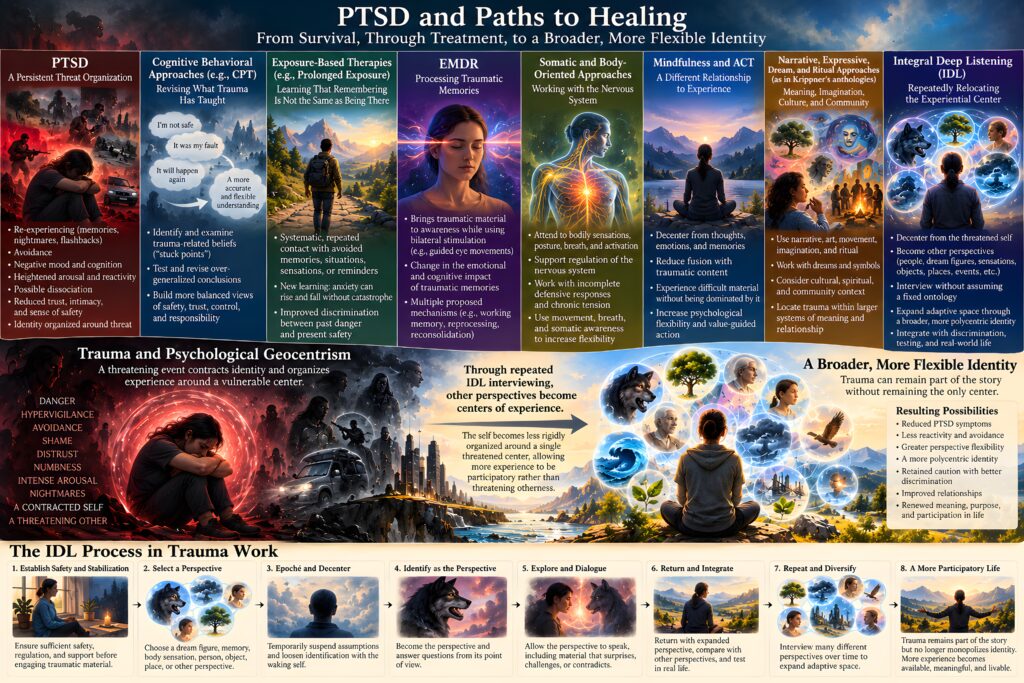
Post-traumatic stress disorder is commonly understood as a persistent disturbance that can develop after exposure to actual or threatened death, serious injury, sexual violence, or other traumatic events. Its symptoms are conventionally grouped around several domains: involuntary re-experiencing of the trauma through memories, nightmares, flashbacks, or physiological reactions; avoidance of reminders; negative alterations in mood and cognition; and heightened arousal and reactivity, which may include hypervigilance, exaggerated startle, irritability, disturbed sleep, and difficulty concentrating.1 Some people experience dissociative symptoms as well.2 Trauma can also affect trust, intimacy, bodily experience, identity, assumptions about safety, and one’s sense of relationship to the surrounding world.
These symptoms can initially be understood as extensions of adaptive survival mechanisms.3 If an organism has survived a genuinely dangerous event, remembering danger, rapidly detecting similar conditions, mobilizing physiological defenses, and avoiding situations associated with the event can all increase the probability of survival. The difficulty is that a response adaptive during an emergency can become maladaptive when it continues to organize perception and behavior after the original emergency has ended.
A combat veteran hears a car backfire and reacts before consciously recognizing that it is not gunfire. A survivor of assault avoids places, situations, people, sensations, or forms of intimacy associated with the attack. A person who survived an accident becomes intensely vigilant while driving. Someone who was traumatized during childhood may have difficulty identifying precisely what is dangerous because interpersonal unpredictability itself has become associated with danger.
PTSD can therefore be understood partly as a disorder of persistent threat organization.4 The nervous system has learned something important—this can happen—but subsequently has difficulty determining when that lesson should and should not govern present experience. That observation helps explain both the effectiveness and limitations of different approaches to trauma treatment.
Cognitive Behavioral Approaches: Revising What Trauma Has Taught
Trauma-focused cognitive behavioral therapies generally address the beliefs, avoidance patterns, memories, and behavioral responses that maintain post-traumatic distress.5 Trauma can generate or strengthen conclusions such as, “The world is dangerous,” “I cannot protect myself,” “It was my fault,” “People cannot be trusted,” “If I think about what happened I will lose control,” or “Because it happened once it can happen at any moment.”
Cognitive therapy examines such conclusions rather than simply reassuring the survivor that everything is safe. Some beliefs may contain considerable truth. Dangerous people do exist. Terrible events do occur. Trust can be betrayed. The therapeutic problem is often overgeneralization: a conclusion learned under extreme conditions becomes the organizing principle for circumstances in which it is no longer appropriate.
Cognitive Processing Therapy, developed particularly for PTSD, works with what are sometimes called “stuck points”—beliefs concerning safety, trust, power and control, esteem, intimacy, responsibility, and the meaning of the traumatic event.6 Treatment helps the person examine whether conclusions formed around the trauma continue to describe present circumstances accurately.
From an IDL perspective, such approaches can be understood as improving adaptive discrimination.7 The problem is not that the survivor learned from trauma. The problem is that a lesson appropriate to one set of circumstances has become too dominant to remain easily revisable.
Exposure: Learning That Remembering Is Not the Same as Being There
Prolonged Exposure and related trauma-focused exposure therapies approach PTSD partly through systematic contact with what has been avoided.8 Instead of continually escaping memories, situations, sensations, or reminders associated with trauma, the survivor encounters them under controlled conditions.
The logic is more sophisticated than simply “face your fears.” Avoidance prevents corrective learning.9 If I always escape when anxiety becomes intense, I may never discover that anxiety can rise and fall without catastrophe. If I never enter situations resembling the traumatic context, my nervous system receives little opportunity to discriminate between the original danger and present conditions.
Contemporary learning theory also emphasizes that exposure need not erase traumatic learning.10 A veteran does not have to forget that explosions are dangerous. Instead, additional learning develops: that sound here, under these circumstances, does not mean what a similar sound meant there.
IDL agrees strongly with the importance of discrimination but approaches the problem from another direction. It asks not only whether the feared stimulus remains dangerous but also how trauma has reorganized the identity that encounters it.
EMDR: Trauma, Memory, and Bilateral Stimulation
Eye Movement Desensitization and Reprocessing combines attention to traumatic memories with bilateral stimulation, most characteristically guided eye movements.11 The person brings aspects of traumatic material to awareness while processing associated imagery, beliefs, emotions, and bodily sensations.
EMDR has accumulated substantial evidence as a treatment for PTSD, although explanations of exactly why it works have been debated.12 Proposed mechanisms have included working-memory taxation, exposure, orienting responses, memory reconsolidation processes, and other forms of information processing.13 Whatever theoretical account ultimately proves most satisfactory, EMDR illustrates an important principle: traumatic memories do not necessarily have to be eliminated for their psychological function to change.
IDL shares that principle. The relevant question is not whether a traumatic memory continues to exist but whether it continues to organize identity, expectation, and behavior as though the traumatic situation were still present.
Somatic and Body-Oriented Approaches
Trauma is not experienced only as narrative memory.14 Heart rate, breathing, muscular tension, posture, startle, gastrointestinal sensations, pain, numbness, freezing, and other bodily experiences may become part of the trauma response. This has contributed to considerable interest in body-oriented and somatically focused treatments.
Some contemporary trauma literature describes traumatic disturbance primarily in terms of dysregulated nervous-system states or incomplete defensive responses.15 Such formulations have been clinically influential, although particular theoretical claims within popular somatic accounts have varying levels of empirical support.
IDL does not require the assumption that trauma is literally “stored in the body.”15 It makes the more modest observation that bodily processes can become participants in the organization of trauma. A tightening chest, trembling hand, painful abdomen, racing heart, or frozen posture can therefore potentially be interviewed.
The methodological move is characteristic of IDL. Instead of only asking, “What does this sensation mean to me?” the person may temporarily become the sensation and answer questions from its perspective.
Mindfulness and Acceptance-Based Approaches
Mindfulness-based interventions and Acceptance and Commitment Therapy introduce another important shift. Rather than attempting to eliminate unwanted thoughts, emotions, and memories, they cultivate a different relationship to them.17
A traumatic memory can occur without becoming identical with present reality. Fear can be experienced without necessarily determining behavior. A thought such as “I am helpless” can be recognized as a thought rather than automatically treated as a literal description of the present.
These approaches are particularly relevant to IDL because they introduce decentering.18 Instead of remaining fused with a thought, feeling, memory, or identity, one develops greater capacity to experience it as one event occurring within a larger field of awareness.
IDL accepts the importance of this movement but adds another. It does not merely ask the traumatized person to observe experience from a less fused position. It repeatedly asks that person to recenter somewhere else.19 This distinction becomes central to an IDL theory of trauma.
Narrative, Expressive, Dream, and Culturally Embedded Approaches
Stanley Krippner’s edited work on trauma is important partly because it broadens the discussion beyond a narrowly medicalized conception of PTSD.20 In anthologies dealing with trauma, post-traumatic stress, dreams, healing, and cross-cultural experience, Krippner and his contributors have drawn attention to narrative, imagery, dreams, expressive methods, spirituality, ritual, indigenous traditions, social relationships, and cultural frameworks through which traumatic experience acquires meaning.21
This broader perspective matters because trauma never occurs entirely outside culture.22 What an experience means, how distress is expressed, what counts as recovery, whom one trusts, how suffering is narrated, and which forms of healing appear legitimate are all affected by social and cultural context.
Narrative approaches help survivors reorganize fragmented or overwhelming experiences into stories that can be understood and communicated. Expressive therapies use art, enactment, movement, imagery, and other symbolic forms when ordinary verbal description is insufficient. Dream work can engage traumatic nightmares and recurring imagery.23 Ritual and communal practices may relocate suffering within shared systems of meaning and relationship rather than treating trauma exclusively as an individual pathology.
Krippner’s anthologies are particularly useful in reminding clinicians that no single explanatory model exhausts trauma. Biological, psychological, interpersonal, cultural, symbolic, spiritual, and political dimensions may all matter, although the evidence supporting particular practices varies substantially.
IDL shares this pluralistic orientation but differs in what it does with the material that emerges.
What IDL Adds: Trauma as a Contraction Around a Threatened Center
Integral Deep Listening begins with a different question. What happens to identity under conditions of overwhelming threat? The working hypothesis is that trauma tends to produce an extreme form of psychological contraction.24 Under danger, this is adaptive.25 There is little advantage in contemplating ten alternative perspectives while someone is attacking you. The organism needs rapid discrimination between self and threat, safety and danger, escape and entrapment. The experiential world becomes organized around a vulnerable center: “I am here. Danger is there. I must survive.”
After trauma, however, that organization can persist. People become dangerous. Crowds become dangerous. Darkness becomes dangerous. Sexuality becomes dangerous. Intimacy becomes dangerous. Anger becomes dangerous. Sleep becomes dangerous because nightmares occur there. Bodily arousal becomes dangerous because it resembles the sensations experienced during the trauma. Memories become dangerous because remembering feels as if it could overwhelm the self. Even one’s own emotions can become threatening others. The geography of otherness expands while the territory experienced as safely “me” contracts.26
IDL calls the more general tendency to organize experience around waking identity psychological geocentrism.27 Trauma may produce an extreme defensive version of it.
This does not imply that psychological geocentrism caused the trauma or that traumatized people are unusually egocentric. The claim is almost the opposite. Defensive centralization may be an intelligent survival response. The problem occurs when an organization precipitated under extreme circumstances becomes resistant to reorganization after those circumstances have changed.28
Decentering Is Only Half the IDL Process
A traumatized person can learn to observe a frightening memory rather than become completely engulfed by it.29 That is important. IDL asks what happens next.
Suppose someone dreams repeatedly of a man chasing her. A conventional interpretation might explore what the man symbolizes. Cognitive work might examine beliefs activated by the dream. Exposure might involve repeatedly recounting or imagining the nightmare. Mindfulness might involve observing the fear and imagery without fusion. A parts-oriented approach might explore whether the pursuer represents a protective, rejected, or burdened part of the person. IDL can make a different move: Become the pursuer or some aspect of the setting.30
For several minutes, waking identity relinquishes its privileged position. The person looks at the dream, the dream self, and perhaps the traumatic situation from the perspective of what had previously been experienced only as threatening or neutral otherness.
This does not mean assuming that the pursuer is secretly benevolent. It does not mean assuming that the pursuer represents the perpetrator. It does not mean assuming that the pursuer is a shadow, archetype, dissociated part, spirit, neurological construction, or hidden wisdom. It does not assume that other elements, such as cars, guns, or buildings are and of these things.
IDL deliberately leaves the ontology indefinite.31 The pursuer and other experiential elements are treated provisionally as perspectives capable of being interviewed.
Trauma and the Occupation of Otherness
This procedure has an unusual implication for PTSD. Trauma organizes experience around the threatened self. IDL repeatedly practices leaving that center. A survivor might identify with a frightening dream figure, a locked door, a shaking hand, a gun, an empty room, a protective wall, an animal, a younger self, an imagined stranger, or an apparently irrelevant dream object such as a tree or kitchen table. The therapeutic significance does not depend entirely upon what any one of these perspectives says. The act of identification itself may matter.32 For a few minutes: “I am not exclusively the traumatized self.” Then: “I am not exclusively the frightened child.” Then:
“I am the door.”
“I am the wolf.”
“I am the trembling.”
“I am the empty house.”
“I am the tree.”
This does not erase the traumatized identity. Instead, repeated identification potentially places it within an expanding ecology of identities.33 IDL hypothesizes that this gradually thins psychological geocentrism.34
From a Traumatized Identity to a Polycentric Identity
This distinction may be particularly relevant to chronic trauma. A traumatic event can become more than something that happened. It can become an organizing identity: “I am the person to whom this happened.” “I am the survivor. “ “I am the victim.”35
That identity may be entirely understandable and factually accurate. The problem arises when it becomes so psychologically central that other possible organizations of identity become difficult to access.
IDL does not attempt to convince the person that he or she is “not a victim,” “not traumatized,” or should stop identifying with what happened. Such interventions can easily become invalidating. Instead, it attempts to increase the number of centers from which life can be experienced. The difference is subtle but important. IDL does not subtract the trauma identity; it adds perspectives around it.36 As additional perspectives become experientially available, the traumatized self can remain real without remaining exclusive.
This is the same principle IDL proposes for anxiety more generally: identity becomes broader because it becomes less monopolized by any single center.
Nightmares as Endogenous Exposure to Otherness
Traumatic nightmares deserve special attention because they occupy an unusual position in PTSD.37 The person may consciously attempt to avoid traumatic material during waking life, yet dreaming repeatedly generates frightening imagery without permission. From an IDL perspective, this makes nightmares potentially important sources of endogenous variation.38
The nightmare is not simply repeating trauma. It is generating characters, environments, transformations, relationships, and perspectives that waking identity does not fully control.
Ordinarily the dream self encounters these elements from approximately the same organization that dominates waking experience: Something frightening is happening to me.
IDL changes the experimental arrangement.
Instead of repeatedly examining the nightmare from the standpoint of the frightened dream self, the person interviews the nightmare elements themselves.
The monster gets a voice. The explosion, abandoned house, dead person gets a perspective, and the wall all get a perspective. The dream self itself can eventually be interviewed as merely one character among others. Dreaming has generated otherness. IDL converts that otherness into participation.39
How This Differs From Parts Work
Parts-oriented therapies can also interview frightened, protective, angry, wounded, or dissociated aspects of experience.40 This overlap should be acknowledged rather than minimized. IDL’s distinction lies in refusing to assume beforehand that interviewed perspectives are parts of the person.41
That matters particularly in trauma because the concept of fragmentation can easily become the organizing metaphor through which every experience is subsequently interpreted. IDL instead maintains indeterminate ontology.
Perhaps the wolf is a part Perhaps it represents the perpetrator. Perhaps it is a metaphor. Perhaps it is simply a product of dreaming. Perhaps the question itself is premature.
The interview can proceed without deciding.
More importantly, IDL does not presume that the goal is to integrate the perspective back into the same waking identity that entered the interview. Perhaps that identity itself requires reorganization.42
Reorganization Rather Than Restoration
This may be the deepest distinction between IDL and many conventional understandings of trauma recovery.
The word recovery can imply returning to what existed before the trauma. Sometimes that is precisely what people want. They want their previous ability to sleep, work, travel, trust, love, concentrate, and enjoy life, but living systems rarely return exactly to their previous organization after major disruption. IDL therefore frames the deeper objective as adaptive reorganization rather than restoration.43
The question becomes not: “How do I get my old self back?” but: “What organization of identity, relationships, behavior, and meaning is adaptive now?” The distinction respects the reality that trauma can permanently alter a life without requiring that it permanently dominate that life.
Trauma as Restriction of Adaptive Space
Adaptive Reorganization Theory provides a larger theoretical framework for this process. Trauma can dramatically restrict adaptive space, meaning the range of perspectives, interpretations, relationships, and behaviors that remain experientially available.44
Avoidance, hypervigilance ,rigid threat expectations, distrust reduces relational space, and trauma-centered identity reduce identity space. Nightmares can reduce willingness to sleep. Dissociation can reduce access to aspects of experience that have become intolerable. The person survives partly by reducing possibilities.45
IDL attempts to reverse this process gradually by expanding participation. The purpose is not maximum openness. A trauma survivor does not become healthier by indiscriminately trusting everyone, abandoning boundaries, or exposing herself to genuine danger. Expansion must be followed by discrimination.
IDL therefore asks not merely whether a perspective can be accessed but whether its recommendations survive comparison with other perspectives, waking judgment, external evidence, and behavioral testing.
This is where IDL’s emphasis on autonomy, reciprocity, confirmation, and reliability—ARCR—becomes relevant. Different perspectives are allowed to participate, but none is automatically granted authority merely because it emerged during an interview.
Where IDL and Established Treatments Converge
IDL consequently overlaps substantially with established trauma treatments. With CBT, it shares an interest in discovering when interpretations have become too rigid. With exposure, it shares willingness to approach rather than continually avoid frightening experience. With EMDR, it shares the assumption that the relationship to traumatic material can change without erasing the memory. With somatic approaches, it recognizes bodily experience as psychologically meaningful. With mindfulness and ACT, it shares decentering and reduced fusion with thoughts, emotions, and identity. With parts-oriented therapies, it shares dialogue with differentiated perspectives. With psychodrama, it shares role reversal and identification. With narrative approaches, it recognizes that trauma reorganizes meaning. With dream-oriented and culturally pluralistic approaches represented in Krippner’s anthologies, it shares respect for imagery, dreams, multiple systems of meaning, and forms of knowledge that cannot be reduced to ordinary waking rationality. IDL combines these elements around a somewhat different hypothesis.
The IDL Hypothesis
IDL proposes that trauma does not merely produce frightening memories or maladaptive beliefs. It can precipitate an organization of identity structured around a threatened center. That organization can be represented as:
trauma → extreme threat → contraction around survival identity → increased self/other polarization → hypervigilance and avoidance → reduced participation → restricted adaptive space → reinforcement of the threatened center
IDL interviewing attempts to introduce a countervailing process: epoché → decentering → identification with non-self perspective → temporary relocation of experiential center → increased participation → expanded adaptive space → discrimination and testing → adaptive reorganization
The distinctive hypothesis is therefore not simply that talking about trauma helps, that exposure reduces avoidance, that mindfulness reduces fusion, that dream work reveals meaning, or that internal perspectives can be therapeutic. It is that repeatedly ceasing to occupy the threatened self as the exclusive center of experience gradually reduces the dominance of the organization that trauma precipitated.
An Important Clinical Qualification
This hypothesis also implies caution. If trauma involves overwhelming loss of control, an intervention that again overwhelms control can reproduce rather than reorganize the problem. Severe dissociation, psychosis, acute suicidality, unstable living conditions, continuing abuse, substance dependence, or overwhelming physiological dysregulation may require stabilization, specialized trauma treatment, medical care, or other interventions before or alongside experiential interviewing.47
IDL should therefore not be presented as a substitute for evidence-based PTSD treatment on the basis of anecdotal experience, nor does the theory predict that everyone should immediately identify with a perpetrator or the most terrifying element of a traumatic experience.48 That could be unnecessarily destabilizing. Adaptive expansion is not forced expansion.
IDL notes that becoming inconsequential elements in the traumatic narrative, like the road, sky, or grass can accomplish decentralization while reducing the possibility of retraumatization. The relevant question is whether sufficient autonomy and stability exist for another perspective to participate without overwhelming the existing organization.
What IDL Would Need to Demonstrate
If IDL is to make a distinctive contribution to PTSD treatment rather than simply redescribe mechanisms already found in established therapies, its hypothesis must be testable.
Repeated IDL interviewing should produce measurable reductions in psychological geocentrism or increases in flexibility of experiential center.49 Those changes should precede and predict improvements in PTSD symptoms. They should explain variance beyond exposure, expectancy violation, cognitive reappraisal, mindfulness, decentering, psychological flexibility, therapeutic alliance, and ordinary perspective-taking. The theory also makes a more unusual prediction.
If IDL changes the organization of identity rather than merely extinguishing particular fears, interviewing perspectives unrelated to the original trauma should eventually produce some generalized benefit.50 Repeatedly becoming trees, animals, dream characters, objects, emotions, strangers, bodily sensations, and other perspectives should gradually make the traumatized identity less exclusive even when those perspectives contain no obvious trauma content.
That prediction distinguishes IDL from a purely trauma-processing model. If only direct processing of traumatic material produces improvement, exposure, cognitive processing, memory reconsolidation, or other established mechanisms may provide more economical explanations.
If repeated identification with diverse non-self perspectives produces generalized changes in identity flexibility that subsequently predict reductions in hypervigilance, avoidance, reactivity, nightmares, and trauma-centered identity, the IDL hypothesis would receive stronger support.
Beyond Making Trauma Safe
The deepest objective of trauma treatment cannot be to convince people that the world is safe. It is not. People can betray us. Accidents occur. Bodies can be injured. Wars happen. Children are abused. People we love die. A therapy based upon persuading survivors that terrible things cannot happen would require them to deny precisely what experience has taught them.
The more adaptive objective is discrimination:
“What is dangerous here?”
“What was dangerous then?”
“What is dangerous now?”
“Which defensive responses remain appropriate?”
“Which have become unnecessarily generalized?”
“Which boundaries protect autonomy?”
“Which boundaries have become prisons?”
And perhaps most fundamentally: “Who is the “I” that must remain perpetually organized around defending itself from what happened?”
IDL approaches that last question experientially rather than philosophically. It repeatedly allows another center to answer.
The traumatized self does not have to disappear. The frightened child does not have to be denied. The survivor does not have to forgive the perpetrator, reinterpret evil as goodness, declare the world safe, or pretend that the trauma was somehow beneficial. Something more modest can occur.
The traumatized identity can become one perspective within an increasingly broad ecology of perspectives.
If the IDL hypothesis is correct, this is one reason repeated interviewing may sometimes reduce the power of trauma. The memory remains, the history remains, and appropriate caution remains, but the identity organized around defending itself against traumatic otherness becomes progressively less exclusive.
Trauma says: “This happened to me, and therefore I must organize myself around the possibility that it will happen again.”
IDL does not answer: “It will never happen again.” It asks something different: “What happens when the “me” around which that fear has organized is no longer the only center from which life can be experienced?”
One conceptual development seems especially promising here: PTSD may provide a stronger test of the psychological-geocentrism hypothesis than ordinary anxiety does. Trauma gives us a plausible evolutionary reason for why identity should contract sharply around a threatened center. The pathology would then lie not in that initial contraction but in its failure to become sufficiently reorganizable once circumstances change. That connects PTSD very naturally with ART’s distinction between initially adaptive precipitation and later restrictive precipitation.
Notes
1. Diagnostic organization of PTSD
The DSM-5-TR organizes PTSD symptoms into four major clusters: intrusion symptoms; persistent avoidance; negative alterations in cognition and mood; and marked alterations in arousal and reactivity. Exposure to a qualifying traumatic event is required, symptoms must persist for more than one month, and they must cause clinically significant distress or impairment. PTSD is therefore more specific than the broad everyday use of the word “trauma.”
American Psychiatric Association. (2022). Diagnostic and Statistical Manual of Mental Disorders (5th ed., text rev.). American Psychiatric Association Publishing.
2. Dissociative presentations
DSM-5-TR includes a dissociative subtype of PTSD involving persistent or recurrent depersonalization and/or derealization. Dissociation is particularly relevant to experiential approaches because deliberately altering identification or perspective should not automatically be assumed beneficial in people whose central difficulty already involves involuntary disruptions in integration, presence, or sense of self.
American Psychiatric Association. (2022). DSM-5-TR.
Lanius, R. A., Brand, B., Vermetten, E., Frewen, P. A., & Spiegel, D. (2012). The dissociative subtype of posttraumatic stress disorder. Depression and Anxiety, 29(8), 701–708.
3. Trauma responses can originate as adaptive responses
Hypervigilance, rapid threat detection, avoidance, autonomic mobilization, and strong memory for dangerous events can all have survival value under conditions of genuine threat. The problem in PTSD is therefore not simply the existence of defensive responses but their persistence, generalization, triggering under relatively safe conditions, and interference with present functioning. This distinction is compatible with learning, cognitive, evolutionary, and neurobiological accounts of PTSD.
Foa, E. B., Huppert, J. D., & Cahill, S. P. (2006). Emotional processing theory. In B. O. Rothbaum (Ed.), Pathological Anxiety. Guilford Press.
LeDoux, J. E., & Pine, D. S. (2016). Using neuroscience to help understand fear and anxiety. American Journal of Psychiatry, 173(11), 1083–1093.
4. PTSD as persistent threat organization
“Persistent threat organization” is used here as a descriptive formulation rather than a formal diagnostic category. Contemporary models emphasize persistent expectations of threat, overgeneralization of danger, altered contextual processing, intrusive memory, and avoidance. Ehlers and Clark, for example, propose that persistent PTSD occurs when trauma is processed in ways that produ
Ehlers, A., & Clark, D. M. (2000). A cognitive model of posttraumatic stress disorder. Behaviour Research and Therapy, 38(4), 319–345.
5. Trauma-focused cognitive-behavioral treatment
Trauma-focused psychotherapies have among the strongest evidence bases for PTSD. Major guidelines commonly recommend interventions such as Cognitive Processing Therapy, Prolonged Exposure, trauma-focused CBT, cognitive therapy for PTSD, and EMDR, although recommendations and terminology vary among professional organizations and health systems.
National Institute for Health and Care Excellence. (2018, updated). Post-traumatic stress disorder (NG116).
U.S. Department of Veterans Affairs & Department of Defense. (2023). VA/DoD Clinical Practice Guideline for Management of Posttraumatic Stress Disorder and Acute Stress Disorder.
6. Cognitive Processing Therapy and “stuck points”
Cognitive Processing Therapy, associated particularly with Patricia Resick and colleagues, addresses maladaptive beliefs arising from or strengthened by trauma. “Stuck points” are beliefs that interfere with recovery and commonly concern safety, trust, power/control, esteem, and intimacy. Responsibility, hindsight bias, self-blame, and beliefs concerning why the trauma occurred can also become central therapeutic targets.
Resick, P. A., Monson, C. M., & Chard, K. M. (2017). Cognitive Processing Therapy for PTSD: A Comprehensive Manual. Guilford Press.
7. Adaptive discrimination is an ART interpretation
“Adaptive discrimination” is ART terminology rather than terminology used in CPT. The reinterpretation proposed here is that trauma treatment frequently improves the person’s ability to discriminate between conclusions that remain useful and conclusions that have become overgeneralized. This ART description should not be mistaken for the theoretical language of CPT itself.
8. Prolonged Exposure
Prolonged Exposure, developed by Edna Foa and colleagues, typically includes psychoeducation, breathing or related coping instruction depending on protocol version, repeated imaginal engagement with traumatic memories, and in vivo engagement with avoided but relatively safe situations. The treatment aims to reduce pathological avoidance and modify trauma-related fear structures through new learning.
Foa, E. B., Hembree, E. A., Rothbaum, B. O., & Rauch, S. A. M. (2019). Prolonged Exposure Therapy for PTSD (2nd ed.). Oxford University Press.
9. Avoidance and maintenance of PTSD
Avoidance can provide immediate relief and is therefore negatively reinforcing. At the same time, persistent avoidance limits opportunities to learn that reminders, emotions, memories, and situations can be tolerated and do not invariably predict renewed catastrophe. Avoidance is therefore central to several influential behavioral and cognitive models of PTSD.
Foa, E. B., et al. (2019). Prolonged Exposure Therapy for PTSD.
Ehlers, A., & Clark, D. M. (2000). A cognitive model of PTSD. Behaviour Research and Therapy, 38, 319–345.
10. Exposure and inhibitory learning
Contemporary exposure theory emphasizes inhibitory or expectancy-violating learning rather than requiring complete erasure of the original fear association. New learning can coexist with older threat learning. This is especially compatible with trauma, where the proposition “terrible things can happen” may remain objectively true even after successful treatment.
Craske, M. G., Treanor, M., Conway, C. C., Zbozinek, T. D., & Vervliet, B. (2014). Maximizing exposure therapy: An inhibitory learning approach. Behaviour Research and Therapy, 58, 10–23.
11. EMDR
EMDR was developed by Francine Shapiro and combines structured attention to traumatic material with bilateral stimulation, usually eye movements. The procedure includes history taking, preparation, assessment, desensitization, installation, body scan, closure, and reevaluation phases.
Shapiro, F. (2018). Eye Movement Desensitization and Reprocessing (EMDR) Therapy (3rd ed.). Guilford Press.
12. Evidence for EMDR
EMDR is included among recommended PTSD treatments in major clinical guidelines. This should be distinguished from agreement about its mechanism. Evidence that a treatment produces benefit does not automatically validate the theory originally proposed to explain that benefit.
World Health Organization. (2013). Guidelines for the Management of Conditions Specifically Related to Stress. WHO.
U.S. Department of Veterans Affairs & Department of Defense. (2023). VA/DoD Clinical Practice Guideline for PTSD.
13. Mechanisms of EMDR remain debated
Working-memory accounts propose that performing a demanding secondary task while recalling an emotional memory reduces its vividness or emotionality because both tasks compete for limited working-memory resources. Exposure, orienting responses, memory updating, and other mechanisms have also been proposed. The mechanism question remains relevant to IDL because apparent treatment uniqueness can sometimes conceal mechanisms shared with existing therapies.
Landin-Romero, R., Moreno-Alcazar, A., Pagani, M., & Amann, B. L. (2018). How does eye movement desensitization and reprocessing therapy work? A systematic review on suggested mechanisms of action. Frontiers in Psychology, 9, 1395.
14. The bodily dimensions of PTSD
PTSD can involve autonomic arousal, startle, sleep disruption, somatic distress, altered interoception, muscular tension, and other bodily experiences. These findings justify attention to bodily experience without requiring stronger claims that trauma is literally stored in particular tissues.
15. Somatic trauma theories require differentiation
Body-oriented trauma approaches include heterogeneous methods and theoretical claims. Some have become highly influential clinically, while their specific proposed mechanisms possess varying degrees of empirical support. It is therefore preferable to distinguish evidence for the importance of bodily and autonomic processes in trauma from stronger claims about “completion” of defensive responses or literal bodily storage of traumatic memories.
16. “Stored in the body” is metaphorically powerful but scientifically imprecise
Memories depend upon distributed nervous-system processes, and traumatic experiences clearly affect physiological responding. However, the popular statement that “the body keeps” or “stores” trauma can obscure distinctions among memory, conditioning, interoception, autonomic regulation, pain, posture, and learned physiological responses. IDL requires only the more modest proposition that bodily sensations can participate meaningfully in traumatic organization and can therefore become targets of phenomenological exploration.
17. Acceptance rather than elimination
ACT emphasizes willingness to experience difficult private events while engaging in behavior guided by values. It therefore differs from models in which treatment success depends upon eliminating distressing thoughts or feelings.
Hayes, S. C., Strosahl, K. D., & Wilson, K. G. (2012). Acceptance and Commitment Therapy: The Process and Practice of Mindful Change (2nd ed.). Guilford Press.
18. Decentering
Decentering refers broadly to experiencing thoughts, emotions, and other subjective events as transient experiences rather than identifying with them as literal definitions of self or reality. Related constructs include metacognitive awareness, cognitive defusion, reperceiving, and self-distancing.
Bernstein, A., Hadash, Y., Lichtash, Y., Tanay, G., Shepherd, K., & Fresco, D. M. (2015). Decentering and related constructs: A critical review and metacognitive processes model. Perspectives on Psychological Science, 10(5), 599–617.
19. IDL proposes decentering followed by recentering
The movement from decentering to identification with another perspective is a specifically IDL hypothesis. Existing research on mindfulness and ACT supports the usefulness of reduced fusion and flexible perspective-taking, but it does not establish that deliberately relocating the experiential center to dream figures, objects, symptoms, animals, or other non-self perspectives produces additional therapeutic effects.
20. Stanley Krippner and pluralistic approaches to trauma
Krippner’s edited volumes are useful because they situate trauma within a broad range of psychological, cultural, symbolic, spiritual, and experiential contexts. Of particular relevance is Post-Traumatic Stress Disorder: Issues and Controversies, edited by Gerald Rosen, with Krippner among contributors to the broader critical discussion of PTSD, and Krippner and McIntyre’s edited The Psychological Impact of War Trauma on Civilians, which examines trauma across cultural and geopolitical settings. Krippner’s extensive work on dreams and extraordinary experience also informs this pluralistic orientation.
Krippner, S., & McIntyre, T. M. (Eds.). (2003). The Psychological Impact of War Trauma on Civilians: An International Perspective. Praeger.
Rosen, G. M. (Ed.). (2004). Posttraumatic Stress Disorder: Issues and Controversies. Wiley.
21. Dreams, imagery, narrative, ritual, and cultural meaning
Krippner’s broader scholarship repeatedly challenges the assumption that psychological phenomena can be understood adequately outside cultural systems of meaning. Trauma responses and healing practices can involve dreams, narratives, ritual practices, spiritual interpretations, family systems, community relationships, and culturally specific understandings of suffering. This does not imply that all such interventions have equivalent empirical support; it argues for distinguishing cultural relevance from evidence of clinical efficacy.
Krippner, S., & McIntyre, T. M. (Eds.). (2003). The Psychological Impact of War Trauma on Civilians. Praeger.
Krippner, S., Bogzaran, F., & de Carvalho, A. P. (2002). Extraordinary Dreams and How to Work With Them. SUNY Press.
22. Trauma is culturally situated
The expression, interpretation, diagnosis, and treatment of trauma vary across cultures. Cross-cultural psychiatry has repeatedly cautioned against assuming that Western PTSD categories exhaust the ways communities understand and respond to catastrophic experience.
Kirmayer, L. J., Lemelson, R., & Barad, M. (Eds.). (2007). Understanding Trauma: Integrating Biological, Clinical, and Cultural Perspectives. Cambridge University Press.
Hinton, D. E., & Lewis-Fernández, R. (2011). The cross-cultural validity of posttraumatic stress disorder. Depression and Anxiety, 28(9), 783–801.
23. Trauma-related nightmares
Nightmares are common intrusion symptoms in PTSD and can persist even when other symptoms improve. Nightmare-focused treatments include Imagery Rehearsal Therapy, in which recurrent nightmares are deliberately rescripted and rehearsed while awake. This literature is particularly relevant to IDL because it demonstrates that changing one’s relationship to nightmare imagery can have therapeutic effects without assuming any particular metaphysical interpretation of dream figures.
Krakow, B., et al. (2001). Imagery rehearsal therapy for chronic nightmares in sexual assault survivors with PTSD. JAMA, 286(5), 537–545.
American Academy of Sleep Medicine. (2018). Position paper for the treatment of nightmare disorder in adults. Journal of Clinical Sleep Medicine, 14(6), 1041–1055.
24. Trauma as contraction of identity is an IDL hypothesis
The proposition that trauma “contracts identity” is not a standard diagnostic claim. It synthesizes observations concerning attentional narrowing, defensive mobilization, avoidance, threat generalization, trauma-related beliefs, and identity disturbance into an IDL theoretical formulation. Research would be required to establish whether this construct explains PTSD outcomes beyond existing variables.
25. Narrowing under acute threat
Acute threat tends to prioritize rapid perception and action relevant to survival. Attentional narrowing and defensive mobilization can therefore be adaptive during actual danger. IDL interprets this as temporary centralization around a survival-oriented identity. The specifically IDL component is the identity interpretation, not the underlying observation that acute threat reorganizes attention and behavior.
26. “Geography of otherness”
The phrase “geography of otherness” is metaphorical. It describes progressive generalization of threat from the original traumatic stimulus to related situations, sensations, relationships, memories, and internal experiences. Fear-generalization research provides an empirical analogue, while the self/other interpretation belongs specifically to IDL.
27. Psychological geocentrism
Psychological geocentrism is an IDL construct describing the tendency to treat waking identity as the implicit center from which experience is evaluated. It should not be equated with selfishness, narcissism, or egocentrism in the ordinary moral sense. The proposed relationship between PTSD severity and defensive psychological geocentrism remains a hypothesis requiring operationalization and validation.
28. From adaptive precipitation to restrictive precipitation
In ART terminology, the defensive organization precipitated by trauma can initially be adaptive because it facilitates survival. The same organization becomes restrictive precipitation when it remains insufficiently revisable after conditions change and suppresses alternative ways of perceiving and responding. This is an ART reinterpretation of phenomena described differently by cognitive, behavioral, and neurobiological models of PTSD.
29. Decentering from traumatic experience
Mindfulness, metacognitive, and acceptance-based approaches demonstrate that a person can learn to experience difficult thoughts, memories, and emotions with reduced fusion. IDL accepts this mechanism while hypothesizing that further benefit may arise when decentering is followed by identification with another experiential center.
30. Identifying with the threatening perspective
Inviting a survivor to “become the pursuer” resembles role reversal in psychodrama, chair work in Gestalt-derived approaches, imagery procedures, and aspects of parts work. Consequently, the procedure itself is not unprecedented. IDL’s proposed distinctiveness lies in combining repeated identification with indefinite ontology and a theory of cumulative decentralization of waking identity.
Moreno, J. L. (1946/1985). Psychodrama, First Volume. Beacon House.
Perls, F. S. (1969). Gestalt Therapy Verbatim. Real People Press.
31. Indefinite ontology
IDL does not require an interviewer to decide whether an imagined perspective is a dissociated part, symbol, archetype, internalized relationship, neural construction, dream simulation, spiritual entity, or something else. This methodological suspension is intended to reduce interpretive imposition. Whether indefinite ontology improves outcomes or produces greater novelty than explicit interpretive frameworks is empirically testable.
32. Identification itself as a candidate mechanism
IDL makes a stronger claim than that useful information emerges from interviews. It proposes that the repeated act of temporarily becoming non-self perspectives may train flexibility of experiential center. This could be tested by comparing IDL identification with dialogue in which participants converse with perspectives while remaining explicitly themselves.
33. Expanding the ecology of identity
The idea of an “ecology of identities” overlaps conceptually with research on self-complexity, multiple self-aspects, perspective-taking, and psychological flexibility. IDL’s stronger claim is that repeated identification with relatively autonomous perspectives produces a progressively polycentric organization rather than merely adding additional self-descriptions.
34. Thinning psychological geocentrism
“Thinning” does not mean weakening personality functioning or producing dissociation. It refers to reducing the exclusive privilege granted to habitual waking identity. A valid measure would therefore need to distinguish healthy perspective flexibility from fragmentation, depersonalization, identity instability, and dissociation.
35. Trauma and identity
Traumatic experience can affect self-concept, autobiographical identity, beliefs about the self, and the organization of personal narratives. The extent to which trauma becomes central to identity has been studied through constructs such as event centrality.
Berntsen, D., & Rubin, D. C. (2006). The Centrality of Event Scale: A measure of integrating a trauma into one’s identity and its relation to post-traumatic stress disorder symptoms. Behaviour Research and Therapy, 44(2), 219–231.
36. Addition rather than invalidation
IDL’s proposal to “add perspectives” rather than argue a survivor out of trauma-related identity is compatible with its broader emphasis on expanding participation. It also avoids implying that a person’s understanding of having been victimized must be surrendered for healing to occur. The empirical question is whether increasing accessible perspectives actually reduces event centrality or its association with PTSD symptoms.
37. Nightmares and PTSD
Recurrent distressing dreams related to traumatic events are recognized intrusion symptoms of PTSD. Their importance is not merely symbolic; nightmares can contribute substantially to sleep disturbance, anticipatory anxiety about sleep, and daytime impairment.
American Psychiatric Association. (2022). DSM-5-TR.
Germain, A. (2013). Sleep disturbances as the hallmark of PTSD. American Journal of Psychiatry, 170(4), 372–382.
38. Dreams as endogenous variation
Calling dreams “endogenous variation” is an ART interpretation. Dreaming generates imagery, characters, environments, emotions, and transformations with reduced deliberate control by waking identity. ART hypothesizes that this can increase internally generated variation available for subsequent selection. That evolutionary-functional interpretation remains theoretical.
39. From dream otherness to participation
IDL differs from ordinary dream interpretation by asking dream elements to participate as interviewed perspectives rather than primarily assigning symbolic meanings to them. The proposed therapeutic mechanism is therefore not discovery of the “correct interpretation” but expansion of participation and perspective diversity.
40. Parts-oriented trauma work
Contemporary parts-oriented approaches, particularly Internal Family Systems, conceptualize the mind as containing differentiated parts that can carry burdens or assume protective roles. Trauma treatment may involve helping the person unblend from and relate compassionately to these parts.
Schwartz, R. C., & Sweezy, M. (2020). Internal Family Systems Therapy (2nd ed.). Guilford Press.
41. IDL versus parts ontology
The distinction is methodological rather than a claim that parts models are incorrect. IDL asks whether therapeutic interviewing can proceed without determining what the perspective “really is.” A direct experiment could compare identical interviews framed as “a part of you” versus “a perspective whose ontology we will leave undecided.”
42. The initial waking identity is not necessarily the endpoint
This is one of IDL’s more consequential theoretical departures. Many therapeutic models aim, explicitly or implicitly, to improve the functioning of the person who entered treatment. IDL asks whether the organization called “the person who entered treatment” may itself need significant reorganization. This does not imply destruction of personality continuity; it predicts greater flexibility in what becomes central to identity.
43. Recovery versus adaptive reorganization
Trauma literature frequently uses “recovery,” but recovery need not literally mean restoration of a pre-trauma state. ART makes this distinction explicit by defining the desired outcome as adaptive reorganization: preserving what remains useful while changing organization in response to altered conditions.
44. Adaptive space
Adaptive space is an ART construct referring to the range of organizations, perspectives, responses, interpretations, and relationships available for selection. It overlaps with psychological flexibility, behavioral repertoire, cognitive flexibility, and resilience but is not identical to any established measure. Its usefulness depends upon developing operational definitions capable of discriminating among these constructs.
45. Survival through restriction
Avoidance, withdrawal, emotional numbing, narrowed trust, vigilance, and rigid routines may all function protectively following trauma. The ART interpretation is that systems sometimes survive by temporarily reducing available variation. Restriction becomes maladaptive when conditions change but the narrowed organization cannot sufficiently reopen.
46. Expansion requires selection
IDL does not assume that more perspectives are necessarily better. Traumatic survivors can already experience intrusive images, conflicting impulses, and overwhelming internal material. ART therefore distinguishes generating alternatives from selecting adaptively among them. IDL’s use of behavioral testing and ARCR is intended to prevent perspective multiplication from becoming an assumption that every emergent voice is trustworthy.
47. Safety and stabilization
Trauma treatment must account for current safety, severe comorbidity, dissociation, suicidality, psychosis, substance use, and ongoing victimization. Contemporary trauma treatment has debated how much stabilization is required before trauma-focused treatment; the evidence does not support a universal rule that lengthy stabilization must always precede trauma processing. Clinical decisions should therefore be individualized rather than derived from a rigid stage model.
U.S. Department of Veterans Affairs & Department of Defense. (2023). VA/DoD Clinical Practice Guideline for PTSD.
Cloitre, M., et al. (2012). The ISTSS Expert Consensus Treatment Guidelines for Complex PTSD in adults. Depression and Anxiety, 29(8), 615–627.
48. Identification should not become forced exposure
IDL’s theory does not imply that the most threatening perspective should always be interviewed first. If autonomy is central to adaptive participation, coercive identification would contradict the theory itself. Gradation, consent, stabilization, and the person’s capacity to return reliably to ordinary functioning are therefore clinically relevant.
49. The central mechanistic prediction
The strongest test of IDL is not whether PTSD symptoms decrease after interviews. Symptom reduction could arise from exposure, expectancy, therapeutic alliance, cognitive change, emotional processing, or other established mechanisms. IDL predicts a more specific causal chain:
repeated perspective identification → reduced exclusivity of waking identity → increased flexibility of experiential center → broader adaptive space → improved threat discrimination → reduced PTSD symptoms.
To support this mechanism, changes in psychological geocentrism should precede symptom change and explain variance beyond established mediators.
Kazdin, A. E. (2007). Mediators and mechanisms of change in psychotherapy research. Annual Review of Clinical Psychology, 3, 1–27.
50. The crucial generalization prediction
Perhaps the most distinctive prediction is that interviews need not always contain trauma material. If repeated identification changes the organization of identity itself, interviews with unrelated dream figures, animals, objects, natural phenomena, or other perspectives should eventually generalize to trauma-related functioning. If improvement occurs only when traumatic material is directly processed, established exposure, cognitive-processing, imagery, or memory-based mechanisms provide more parsimonious explanations.
A strong experimental design could therefore compare:
trauma-focused IDL interviewing with non-trauma-focused IDL interviewing with trauma-focused exposure or cognitive treatment and matched supportive interviewing.
If both forms of IDL increase measurable flexibility of experiential center, and that change subsequently predicts PTSD improvement, the psychological-geocentrism hypothesis would receive substantially stronger support.