
Trauma and Imaginal Memory: An Adaptive Reorganization Approach
Joseph Dillard/ChatGPT
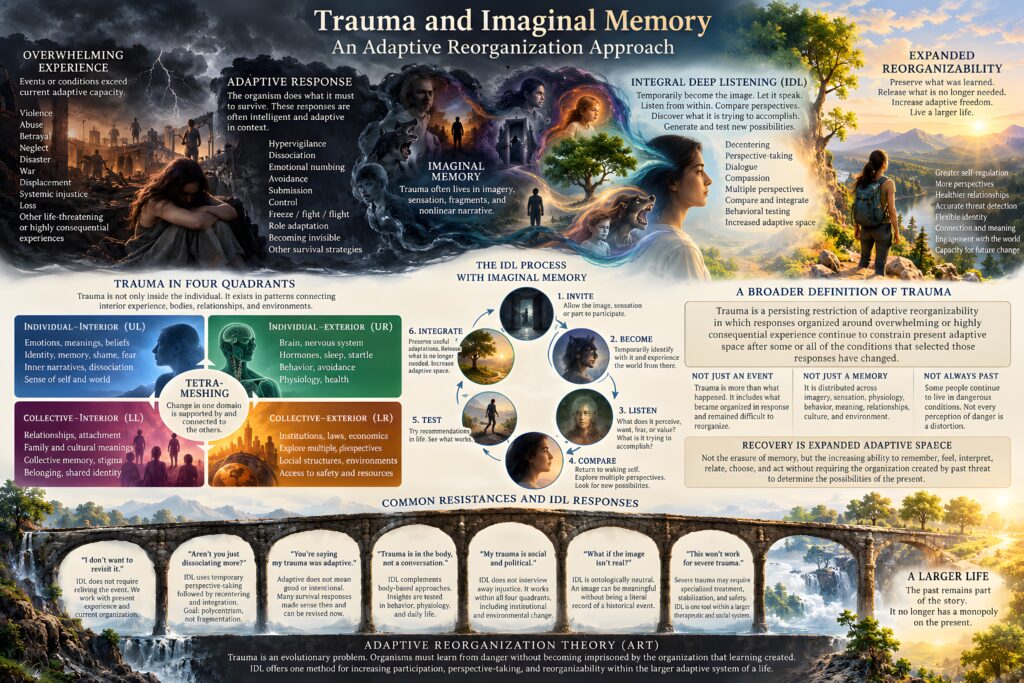
Trauma is commonly understood in relation to events that overwhelm a person’s capacity to cope: violence, abuse, disaster, war, catastrophic loss, serious injury, betrayal, neglect, or other experiences involving actual or perceived threat.1 Clinical definitions appropriately narrow the concept further when diagnosing disorders such as post-traumatic stress disorder. Such definitions are necessary. Without boundaries, “trauma” can expand until virtually every painful experience becomes traumatic, at which point the concept loses much of its usefulness.
Yet clinical definitions of trauma do not exhaust the phenomenon they describe. They are designed primarily to identify particular patterns of exposure, symptoms, impairment, and treatment need. They do not necessarily answer a broader question: What is trauma doing to the organization of a life?
Adaptive Reorganization Theory, or ART, approaches trauma from this second direction. It does not propose replacing psychological, neurological, social, medical, developmental, or spiritual understandings of trauma. It asks whether they can be situated within a more inclusive adaptive framework.
From this perspective, trauma is not merely something terrible that happened to someone. Nor is it simply the memory of such an event. Trauma can be understood as a persisting organization generated when overwhelming or highly consequential experience produces adaptations that cannot subsequently be adequately revised, integrated, or reorganized as conditions change.2
This shifts attention from the traumatic event alone to the relationship among event, response, stabilization, present environment, and reorganizability.
The distinction matters because an organism has no choice but to adapt to what happens to it. During danger, hypervigilance may be adaptive. Dissociation may reduce unbearable experience. Submission may prevent further injury. Emotional numbing may allow functioning to continue. Avoidance may reduce exposure to danger. A child who learns to become invisible around a violent parent may be making an extraordinarily intelligent adaptation within an extraordinarily bad situation.
The difficulty arises when an adaptation that increased survival under one set of conditions becomes stabilized under another.3
The child becomes an adult. The dangerous environment disappears, but the organization constructed within it remains. Intimacy activates vigilance. Disagreement activates submission. Ambiguity activates threat detection. Bodily arousal becomes evidence of impending catastrophe. Emotional closeness triggers withdrawal. An unexpected sound mobilizes a nervous system organized for danger.
The person may understand perfectly well that the present is not the past while nevertheless responding as if some important part of the past remains present.
From an ART perspective, this suggests a deceptively simple proposition: Trauma is not only what overwhelmed us. Trauma also concerns what became organized in response to being overwhelmed and subsequently became difficult to reorganize.
Trauma as Adaptive Precipitation
ART uses the term precipitation for the stabilization of organization. Experiences disappear; their consequences do not necessarily disappear with them. What has been learned precipitates into neural pathways, bodily expectations, habits, interpretations, relationships, identities, institutions, narratives, and environments.
Most precipitation is indispensable. Without it we would continually have to reconstruct ourselves from nothing.
Trauma presents a special case because adaptations formed under extraordinary conditions may become unusually resistant to revision. An organism that has encountered severe danger has good reason to err toward remembering it. From the standpoint of immediate survival, a false alarm is often less costly than failing to recognize a genuine threat.
The problem is therefore not that the traumatized organism has failed to adapt. In many cases, precisely the opposite may be true. It adapted extremely well to conditions that no longer exist.4
This formulation changes the therapeutic question. Instead of asking only, “How do we eliminate the traumatic response?” we can ask:
“What was this organization attempting to accomplish?”
“What does it still believe it must accomplish?”
“Which conditions that originally selected it remain present?”
“Which no longer do?”
“What information is unavailable to it?”
“What alternatives can now be generated?”
“What should be preserved?”
“What can safely become reorganizable?”
This does not romanticize trauma. Some consequences of overwhelming experiences are devastating. Nor does it imply that every trauma response was optimally adaptive. Biological systems improvise under constraints. They make tradeoffs. They can generate damaging responses. What ART adds is a reluctance to assume that dysfunctional behavior is meaningless merely because it has become maladaptive.
The question becomes not simply, “What is wrong?” but “What organization has occurred, why might it have occurred, and under what conditions can it reorganize?”
Trauma Is More Than Memory
We often speak of trauma as though a traumatic memory were a damaged recording stored somewhere inside the person. Therapy then appears to involve retrieving, processing, correcting, extinguishing, reconsolidating, or integrating that recording. There is truth in this metaphor, but it can also mislead.
Memory is reconstructive. What persists after trauma is distributed across multiple processes: explicit recollection, implicit learning, physiological responses, attentional biases, expectations, interpretations, avoidance patterns, interpersonal behavior, sensory associations, dreams, imagery, and identity.5
A person may therefore say, quite accurately, “I know I am safe,” while simultaneously experiencing a racing heart, constricted breathing, muscular tension, an impulse to escape, an image of catastrophe, and the certainty that something terrible is about to happen. Which one is the trauma?
ART suggests that this may be the wrong question. The more useful unit of analysis may be the organization connecting these responses. Trauma in this broader sense is not located exclusively in the brain, body, memory, narrative, relationship, culture, or environment. It exists in patterns connecting them.6 This is one reason Integral theory’s four-quadrant framework is useful.7
Trauma in Four Quadrants
From an upper-left, individual-interior perspective, trauma may involve fear, shame, helplessness, intrusive imagery, fragmented memories, meanings, beliefs, identity, nightmares, dissociation, and altered assumptions about oneself and the world.
From an upper-right, individual-exterior perspective, it may involve autonomic activation, sleep disruption, startle responses, conditioned reactions, behavioral avoidance, neuroendocrine processes, changes in attention, and other observable physiological and behavioral phenomena.
From a lower-left, collective-interior perspective, trauma may involve attachment, family meanings, cultural narratives, collective memory, stigma, belonging, betrayal, moral expectations, shared identity, and the ways communities interpret suffering.
From a lower-right, collective-exterior perspective, trauma may involve war, poverty, displacement, institutional violence, abusive family systems, dangerous workplaces, discriminatory structures, legal arrangements, healthcare systems, economic conditions, and material environments that perpetuate threat.
These are not four competing explanations. A refugee can simultaneously have intrusive memories, elevated physiological arousal, a shattered sense of belonging, and an unresolved legal status that objectively keeps life precarious. Treating only one quadrant risks mistaking one dimension of the problem for the whole.
This is particularly important because some therapeutic language unintentionally relocates environmental problems inside the survivor. Not every perception of danger is a cognitive distortion.8 Not every hypervigilant person lives in a safe environment. Not every traumatized employee needs greater emotional regulation; some need protection from an abusive workplace. Not every traumatized population needs psychological treatment while the conditions producing trauma remain unchanged.
An adaptive account therefore has to ask two different questions: “Is the organism continuing to respond to a danger that has ended?” and “Is the organism accurately responding to a danger that continues?”
Confusing these can be consequential.
From Four Quadrants to Tetra-Meshing
IDL attempts to work with all four quadrants without claiming that interviewing alone can treat all of them. That qualification is essential.
An IDL interview may alter someone’s relationship to fear, but it cannot stop artillery fire. It may reveal a neglected perspective on an abusive relationship, but it cannot substitute for physical protection. It may reduce identification with despair, but it cannot provide housing, legal status, medication, income, community, or medical care when these are needed. Tetra-meshing therefore cannot mean imagining that interior transformation magically reorganizes exterior reality.9 It means asking whether change in one domain is adequately supported by the others.
An interior realization may require behavioral experimentation. Behavioral change may require relational support. Relational change may require institutional protection. Physiological dysregulation may require medical assessment. A changed environment may still leave internal adaptations that require revision.
IDL’s contribution lies principally in increasing participation within this larger system and then connecting what emerges to behavioral testing and environmental feedback.
This is where imaginal memory becomes particularly interesting.
Why Imagery?
Trauma frequently appears in forms that are not organized as calm autobiographical propositions.10 It appears as a doorway, a face, a smell, a pressure in the chest, a dark corridor, a recurring nightmare, a frozen child, a sensation of being trapped, an impulse to run, a monster, a blank space, or as an image that makes no rational sense but carries enormous emotional force.
Psychology has many ways of understanding such phenomena. They may be approached as conditioned associations, memory fragments, symbolic representations, dissociative phenomena, intrusive imagery, affective states, embodied memories, schemas, parts, or products of predictive processing.
IDL does not require choosing among these ontologies before working with them. Instead, it adopts a deliberately modest position: Whatever this image ultimately is, what happens if we temporarily allow it to participate?11 This is an important methodological move.
The frightening image is normally experienced as an object by the waking self. “I am here; it is there.” “I am frightened; it frightens me.” “I want it to disappear.”
IDL temporarily changes that relationship. Rather than merely looking at the image, the person is invited, when appropriate and tolerable, to imagine becoming it.
What does the doorway experience?
What does the frightened child want?
What does the pressure in the chest think is happening?
What does the monster believe its function is?
What does the blankness perceive?
What does the nightmare pursuer think about the dreamer?
This does not establish that the image is an autonomous entity, dissociated personality, archetype, neurological module, spirit, unconscious intelligence, or “true self.” IDL deliberately leaves that question open. Its methodological wager is simpler: changing identification may change the information available to the system.
From Imaginal Content to Imaginal Participation
This distinguishes interviewing from interpretation.
When we interpret an image, waking identity remains at the center and asks: “What does this mean to me?”
When we interview it, we temporarily ask a different question: “What does experience look like from there?”
That small shift may have considerable consequences.
The person who has spent years trying to escape a frightening image may discover that the image does not experience itself as frightening. A pursuer may describe itself as protective. A wall may value boundaries. A dead landscape may report tranquility rather than despair. A threatening animal may experience strength without experiencing fear.
None of these responses should automatically be treated as hidden truth. Their importance lies elsewhere. They represent alternative organizations of experience generated from within the same person.12 In ART terminology, they potentially expand adaptive space.
Trauma as a Constriction of Adaptive Space
This leads to a second possible ART contribution.
Trauma often restricts the number of responses that feel possible: Fight, run, freeze, submit, avoid, control, dissociate, stay vigilant, do not trust, do not feel, do not remember. Never let this happen again.
Again, such restrictions may originally have been adaptive. Under extreme threat, unlimited choice is not necessarily helpful. Rapid selection among a narrow repertoire may save a life, but after danger has passed, the same narrowing can become costly.
ART therefore suggests another working formulation: Trauma can be understood partly as a persistent restriction of adaptive space produced by organization that remains structured around conditions of threat.13
This does not replace established definitions of trauma. It describes a particular functional consequence that may accompany some traumatic adaptations. Recovery then involves more than reducing symptoms. It may involve safely restoring degrees of adaptive freedom.
“Can I experience arousal without automatically interpreting it as catastrophe?”
“Can I remember without becoming the person I was then?”
“Can I encounter disagreement without experiencing annihilation?”
“Can I establish boundaries without total withdrawal?”
“Can I recognize danger without living inside danger?”
“Can I experience vulnerability without equating vulnerability with helplessness?”
The issue is not maximum openness. Someone who indiscriminately trusts everyone has not transcended trauma; they have lost discrimination.14
ART’s goal is therefore not unlimited adaptive space; it is expanded alternatives combined with improved selection.
From Traumatic Precipitation to Impaired Adaptive Selection
Understanding trauma as a restriction of adaptive space takes us further than understanding it simply as an injury, memory, or collection of symptoms, but it still does not go far enough. Restricted adaptive space describes a consequence of trauma without fully describing the adaptive sequence that produces and maintains it. ART suggests that we can distinguish at least three related processes:
traumatic precipitation → restricted adaptive space → impaired adaptive selection and reorganization.32
The first involves stabilization. Something overwhelming or highly consequential occurs, and the organism responds with whatever resources are available. Attention narrows. Danger becomes highly salient. Certain cues acquire significance. Particular behaviors become more probable. Avoidance, vigilance, submission, aggression, emotional numbing, dissociation, or attempts to control the environment may become organized responses. Memories, bodily reactions, expectations, interpretations, and interpersonal strategies can become associated with one another. What was initially a response to extraordinary circumstances gradually becomes part of the relatively stable organization of the person.
ART calls this traumatic precipitation. The term is not intended to suggest that all trauma responses are adaptive or that traumatic experience somehow improves the person. It describes the stabilization of organization generated under conditions of overwhelming or highly consequential mismatch. Some elements of that organization may have supported survival or functioning. Others may have been incidental, costly, or maladaptive from the beginning. What matters is that they have become sufficiently stabilized to influence subsequent perception, interpretation, feeling, and behavior.
The second process is a restriction of adaptive space. Once danger-related organization has precipitated, some possibilities become easier to perceive and enact while others become harder to recognize. Avoidance makes approaching less available. Hypervigilance makes relaxed attention more difficult. Expectations of betrayal can make trust harder to consider. Submission can make assertion seem dangerous. Emotional numbing can make engagement costly. A person does not necessarily consciously decide that these alternatives are impossible. The organization of experience itself may make them less available, yet even this does not identify what may be the deeper adaptive problem.
The third process concerns selection. An adaptive system does not benefit simply from possessing many alternatives. It must discriminate among them. It must distinguish danger from safety, relevant signals from irrelevant ones, useful responses from harmful ones, and conditions requiring an old response from conditions permitting something new.
Research on fear generalization provides a particularly concrete example. Following fear learning, responses can generalize from cues associated with genuine danger to other stimuli that resemble them. In PTSD, research has found evidence of broader fear generalization and difficulties with safety discrimination.33 The problem is therefore not simply that fear remains present. The organism may become less precise in determining when fear is warranted and when it is not.
Suppose a person who has experienced betrayal concludes, implicitly or explicitly, that other people cannot be trusted. The problem is not merely that the person possesses too few perspectives. Nor would the solution be to replace “people cannot be trusted” with “people can be trusted.” Either rule, applied indiscriminately, can be maladaptive. The more important capacity is discrimination.
Who is trustworthy? Under what conditions? Regarding what? What evidence should increase trust? What evidence should reduce it? How quickly should trust be extended? What happens when expectations are violated? What would justify revising the judgment?
Trauma can therefore present a double adaptive problem. It may reduce the range of alternatives available for consideration while simultaneously degrading the processes by which alternatives are selected.34
This suggests a broader and potentially testable ART hypothesis. What fear-generalization research demonstrates within a relatively specific domain may have analogues at other levels of organization. Trauma may sometimes produce losses of adaptive discrimination across emotion, cognition, identity, relationships, and behavior.
A person may have difficulty distinguishing arousal from danger, vulnerability from helplessness, disagreement from rejection, authority from domination, closeness from engulfment, uncertainty from catastrophe, remembering from reliving, or the person I was during the trauma from the person I am now.
These are not necessarily conscious conceptual errors. They may be deeply embodied, emotionally conditioned, relationally reinforced, and environmentally maintained. Nor should they automatically be called distortions. Sometimes authority really is dominating, vulnerability really does increase risk, and interpersonal cues really do predict danger. Adaptive discrimination requires retaining the capacity to recognize these realities while becoming more precise about when they apply. From this perspective, the objective of trauma recovery cannot simply be less fear. It must include better discrimination.
This reframes the possible contribution of Integral Deep Listening.
If IDL merely generated additional perspectives, its therapeutic rationale would remain incomplete. More perspectives can produce greater understanding, but they can also produce confusion. An imaginal figure may offer a useful recommendation, an irrelevant association, an expression of fear, a fantasy, a cultural assumption, or something the person does not yet understand. Nothing about an IDL interview guarantees that a perspective is wise.
IDL therefore proposes a sequence rather than simply an expansion of perspectives. The existing organization encounters mismatch. Instead of immediately applying its habitual response, participation is expanded. Dream figures, bodily sensations, imaginal elements, alternative identities, other people, clinical knowledge, and relevant external evidence may contribute perspectives. This expands adaptive space by making additional organizations available, but expansion must then be followed by discrimination.
Perspectives are compared rather than automatically believed. Recommendations are evaluated in relation to autonomy, reciprocity, confirmation, and reliability. Promising possibilities are translated into sufficiently small and reversible behavioral experiments. Their consequences are observed. What works can be retained. What fails can be revised or abandoned. The resulting organization then becomes the starting point for another adaptive cycle.35
The relevant ART sequence for trauma therefore becomes:
traumatic precipitation → mismatch → expanded participation → expanded adaptive space → discrimination → behavioral testing → adaptive selection → adaptive reorganization → renewed precipitation.
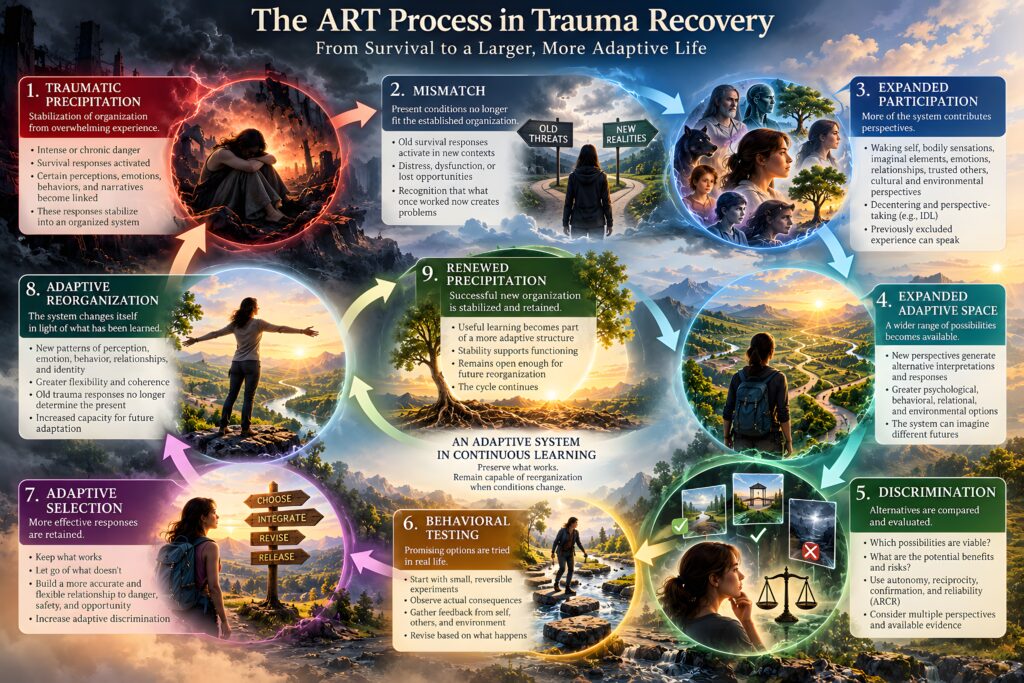
This sequence changes how we understand the goal of imaginal interviewing. The objective is not to replace a traumatized identity with a collection of supposedly wiser imaginal identities. Nor is it simply to become more open, imaginative, flexible, or accepting. The objective is to improve the system’s capacity to generate, discriminate among, test, and retain responses appropriate to present conditions. Seen this way, trauma reveals an evolutionary dilemma.
Organisms must learn from danger. An organism that repeatedly forgets danger will not survive for long. Severe experiences therefore should affect future perception and behavior.
The capacity to remember threat is not an evolutionary mistake, but successful threat learning creates another problem. If learning becomes too generalized, too dominant, or too resistant to correction, yesterday’s danger can unnecessarily determine tomorrow’s possibilities. The organism has successfully preserved information while becoming less capable of determining when that information remains relevant.
Trauma therefore exposes a problem that reaches far beyond trauma: How can an adaptive system preserve what experience has taught it without allowing yesterday’s successful learning to unnecessarily restrict tomorrow’s adaptive possibilities? This is the larger problem that ART attempts to address.
Precipitation preserves learning. Expanded participation generates alternatives. Adaptive space makes alternatives available. Discrimination compares them. Behavioral testing subjects them to consequences. Adaptive selection retains what works. Reorganization changes the system when its existing organization has become part of the mismatch. Renewed precipitation stabilizes what has now proven useful. The objective is consequently neither permanent flexibility nor permanent stability. It is the capacity to move between them.
From this perspective, trauma recovery involves something more precise than becoming less rigid. It involves recovering the capacity to differentiate the past from the present sufficiently well to allow the past to inform present selection without automatically determining it.
That may be one of the most important meanings of adaptive reorganizability in trauma: not forgetting danger, but becoming increasingly capable of determining which dangers, which responses, under which conditions, remain relevant now.
The Importance of Psychological Geocentrism
IDL adds another hypothesis. Trauma can powerfully centralize identity around the threatened self. This is understandable. If I am in danger, the distinction between me and what threatens me becomes critically important. Attention contracts. Survival priorities dominate. Experience becomes organized around what is happening to me.
IDL calls the broader tendency to organize experience around waking identity psychological geocentrism.15This is not narcissism. It is a normal feature of human consciousness.
The problem arises when the traumatized identity becomes the unquestioned center from which all relevant experience must be interpreted.
Repeated identification with alternative imaginal perspectives may gradually loosen that monopoly. The survivor does not cease being themselves, nor is their history denied. Instead, the traumatized identity becomes one valid perspective among an expanding ecology of perspectives. That difference is crucial.
IDL does not necessarily attempt to convince the frightened self that it is wrong. It attempts to create conditions in which frightened identity no longer has to carry the entire burden of defining reality.
“But Aren’t You Just Dissociating More?”
This is an important objection. If trauma can already involve fragmentation, why encourage people to become imaginary characters, dream figures, bodily sensations, or alternative perspectives? Could this increase dissociation rather than integration? It could be mishandled. That is why perspective-taking should not be confused with abandoning identity.
IDL’s sequence involves decentering followed by recentering. One temporarily adopts another perspective and then returns, compares perspectives, evaluates recommendations, and tests useful possibilities in ordinary life.
The objective is not fragmentation but polycentrism: increasing the capacity to inhabit multiple perspectives without requiring any one of them to become absolute.16
The difference resembles visiting another country versus forgetting where you live. Healthy perspective-taking allows movement. Pathological fragmentation can involve losing control over that movement.
Trauma-informed IDL therefore requires attention to pacing, consent, stability, grounding, tolerance, and the person’s capacity to enter and leave imaginal identification safely. Severe dissociation, psychosis, acute instability, ongoing danger, or overwhelming activation require appropriate clinical judgment and may make particular procedures unsuitable or require specialized treatment.
The ART principle is not “more perspectives are always better.” It is increase adaptive space only at a rate the system can usefully discriminate and integrate.17
“I Don’t Want to Revisit It”
Another resistance is equally reasonable. Many survivors have no desire to relive traumatic experiences, and some have encountered therapeutic approaches that seemed to require precisely that.
IDL does not need to assume that healing requires repeatedly recounting traumatic events. A person can begin with what exists now: A sensation, a current relationship difficulty, a nightmare, an image, an emotion, or a life issue.
The purpose is not necessarily to reproduce the original event with greater intensity. It is to investigate the present organization associated with it. This makes possible a useful distinction between historical reconstruction and functional reorganization.18 We may never know exactly what happened internally during an event decades ago. Memory is fallible. Interpretations change. Details disappear, but we can investigate how experience is organized now.
What triggers what? What identities appear? What predictions are being made? What possibilities are excluded? What perspectives are unavailable? What happens when identification changes? What recommendations emerge? What occurs when they are tested?
In this regard, IDL is detective work. These questions explore clues to a mystery. IDL enquires of various participants at the scene of the “crime.” What did they see? What did they experience?
For ART, therapeutic progress does not require possessing a perfect archaeological reconstruction of the past. It requires increasing the adaptive capacity of the present system.
“You’re Saying My Trauma Was Adaptive”
That formulation can understandably provoke resistance. Calling traumatic responses “adaptive” can sound like saying trauma was good, necessary, beneficial, or somehow intended. None of those conclusions follows.
In evolutionary language, adaptive is not a moral compliment. An adaptation is a response that improves functioning or survival relative to particular conditions and constraints.19 Something can be locally adaptive while producing terrible long-term costs.
A child’s emotional numbing might help them survive an intolerable household while making adult intimacy difficult. Hypervigilance might be useful in combat and exhausting in civilian life.
The ART perspective therefore does not say: “Your trauma was good for you.” It asks: “Which responses made sense under those conditions, and which of them remain necessary now?” That formulation can preserve respect for survival responses without turning them into permanent identities.
“Trauma Is in the Body, Not an Imaginary Conversation”
This objection also contains an important truth.
Trauma can involve profound physiological conditioning and autonomic responses. Talking differently about an experience does not necessarily reorganize them. IDL should not claim otherwise. Its answer is empirical rather than ideological.
If an imaginal interview produces an interesting conversation but nothing changes in sleep, startle response, avoidance, relationships, emotional regulation, physiological tolerance, decision-making, or everyday functioning, the interview has limited therapeutic significance.20 That is why ART emphasizes behavioral testing. Insight is not the endpoint. A useful imaginal perspective should eventually alter something observable. The body therefore becomes not an opponent of imaginal work but one of the places where its value can be tested.
“My Trauma Was Social and Political”
A four-quadrant approach must take this objection particularly seriously. People are traumatized by wars, forced migration, racism, persecution, poverty, institutional betrayal, family systems, sexual violence, political repression, and economic insecurity. Reducing these experiences to individual psychology can become another form of invalidation.
IDL cannot interview away structural violence. ART instead distinguishes between endogenous and exogenous sources of mismatch. Sometimes the system itself requires reorganization and sometimes the environment does.21 Usually both interact.
A person living in ongoing danger may require protection before psychological reinterpretation. A traumatized community may require justice, restitution, institutional reform, recognition, or material reconstruction. Individual therapeutic work may support those processes, but it cannot substitute for them.
Tetra-meshing therefore prevents IDL from making the opposite error from reductionist materialism. Trauma is neither merely “inside” the individual nor merely imposed from outside. It emerges within relationships among organisms, meanings, bodies, cultures, institutions, histories, and environments.
Imaginal Memory Without Imaginal Literalism
IDL’s indefinite ontology becomes particularly important here.
Trauma work can make images feel intensely real. A person may encounter a child, perpetrator, animal, guardian, corpse, demon, parent, or other figure that speaks with surprising autonomy. IDL neither dismisses such experiences as “only imagination” nor automatically treats them as literal recovered memories. That distinction is ethically important.
Imaginal truth and historical truth are not identical. An image may be psychologically meaningful without documenting an event. A dream may reveal fear without proving its historical cause. An imagined child may express vulnerability without establishing that a particular remembered episode occurred exactly as represented.
This protects two forms of reality simultaneously. Subjective significance deserves respect.22 Historical claims require independent evidence. IDL’s refusal to settle ontology prematurely is therefore not merely philosophical caution. In trauma work it becomes a safeguard.
Trauma and the Four Forms of ARCR
ART’s principles of autonomy, reciprocity, confirmation, and reliability also take on distinctive meanings in trauma.
Autonomy means that the survivor retains meaningful control over participation, pacing, boundaries, interpretation, and action. It also means that interviewed perspectives are initially allowed enough independence to speak without being immediately corrected by waking identity.
Reciprocity means that experience is approached relationally rather than conquered. The waking self listens to other perspectives, and those perspectives are questioned in return. Neither is automatically granted absolute authority.
Confirmation means that what emerges from an interview is not accepted merely because it feels profound. Perspectives can be compared with one another, with waking experience, with trusted others, with clinical knowledge, and with observable consequences.
Reliability means following promising insights into repeated behavior and seeing whether they continue to work. Recommendations that survive testing acquire greater credibility. Those that do not are revised or discarded.
This prevents imaginal work from becoming another belief system.23 The interview generates possibilities. Life selects among them.
Trauma as Failed Reorganization?
There is one further possibility worth considering, although it should be stated carefully. Perhaps some persistent trauma is not best understood as damage stored from the past but as an unfinished adaptive reorganization.24 Something happened that made the previous organization of the person no longer completely viable:
“The world was safe; then it wasn’t.”
“Adults were trustworthy; then one wasn’t.”
“My body belonged to me; then its boundaries were violated.
“I could protect my child; then I couldn’t.”
“My nation was home; then I became a refugee.”
“I was a competent professional; then disaster overwhelmed everything I knew how to do.”
Such events do not merely generate fear. They can destroy organizing assumptions. The system must somehow reorganize around realities it did not previously contain.
But what if it cannot? Then trauma may persist partly because the old organization cannot be restored while a sufficiently viable new organization has not yet emerged. The person becomes caught between worlds.25
ART would describe this not simply as remembering something terrible but as an adaptive transition that has become constrained. That interpretation could help explain why symptom elimination alone sometimes feels insufficient to survivors. The task may include constructing a viable organization capable of containing both:
“That happened.” and “My life is larger than what happened.”
The second statement does not negate the first; it places it within a larger adaptive organization.
From Integration to Reorganizability
“Integration” is one of the most common goals in trauma therapy, and appropriately so. ART introduces a slight modification.
Integration can imply that fragmented elements need to be assembled into a coherent whole. That is valuable, but coherence can itself become rigid.26 ART therefore proposes an additional criterion: reorganizability.
A recovered person is not necessarily someone who has finally constructed the correct story about what happened. A more ambitious goal is someone who can encounter future mismatch without requiring their entire organization to collapse or retreat automatically into the adaptations generated by the original trauma.
Recovery then becomes less like repairing a broken vase and more like developing a living system capable of changing shape without losing continuity.27
That includes resilience but goes somewhat beyond it. The question is not merely: “Can I return to who I was?” It is: “Can I continue becoming differently organized without losing what remains worth preserving?”
Trauma as an Evolutionary Problem
Seen from this perspective, trauma belongs to a much larger family of adaptive problems. Organisms must learn from danger, but they must not learn so rigidly that yesterday’s danger controls tomorrow’s possibilities. They must preserve memory, but memory must remain revisable. They must develop identities, but identities must remain permeable enough to learn. They must detect threats rapidly, but threat detection must remain correctable. They must stabilize successful adaptations, but stabilization must not eliminate reorganizability. This is the evolutionary dilemma that ART sees beneath trauma.
Trauma is therefore not interesting to ART merely because it causes suffering. It represents an unusually clear example of the fundamental problem ART attempts to understand: How can an adaptive system preserve what experience has taught it without becoming imprisoned by the organization that learning created?28 IDL offers one experimental response.
It does not ask the traumatized self to surrender its history. It does not declare fear irrational. It does not insist that frightening images contain hidden wisdom. It does not assume that every problem can be solved internally, and it does not require metaphysical beliefs about what interviewed perspectives “really” are. It asks something considerably more modest. “Can more of the system participate in its own reorganization?”
A nightmare, bodily sensation, fand a frightening image can participate. The waking self and other people can participate. Clinical knowledge, physiology, culture and material conditions can participate. Eventually behavior and consequences participate by determining which possibilities actually work.
This is where IDL’s relationship to trauma becomes different from simply offering another technique for reducing fear. The aim is not to silence the traumatized perspective, nor is it to enthrone it. The aim is to place it within a sufficiently broad field of participation that it no longer has to organize the entire system by itself.
From that perspective, healing does not mean forgetting what happened, denying what was done, forgiving what should not be excused, declaring danger unreal, or returning to some imaginary pre-traumatic self. It means increasing the capacity to preserve what the past genuinely taught while becoming progressively freer from adaptations that the present no longer requires.
Perhaps the most concise ART definition of trauma is therefore this: Trauma is a persisting restriction of adaptive reorganizability in which responses organized around overwhelming or highly consequential experience continue to constrain present adaptive space after some or all of the conditions that selected those responses have changed.29
That definition should not replace medical, psychological, neurological, social, legal, or cultural definitions. It serves a different purpose. It describes trauma as an adaptive systems problem and it generates a corresponding definition of recovery:
Trauma recovery is not the erasure of traumatic memory but the restoration and expansion of adaptive reorganizability: the increasing ability to remember, feel, interpret, relate, discriminate, choose, and act without requiring the organization created by past threat to determine the possibilities of the present.30
Imaginal interviewing can then be understood as one possible method for contributing to that process. By allowing imagery, sensations, dreams, and other relatively autonomous expressions of experience to become perspectives rather than merely symptoms or objects of interpretation, IDL attempts to increase endogenous participation. By temporarily shifting identification, it attempts to weaken psychological geocentrism. By comparing perspectives, it attempts to improve discrimination. By testing recommendations in behavior, it subjects imaginal insight to external correction. By including relationships, bodies, environments, and institutions, it attempts to tetra-mesh interior reorganization with the larger world in which adaptation actually occurs.
The deepest purpose is therefore not to make traumatic imagery disappear; it is to change the organization within which that imagery occurs.
A traumatic image may remain part of one’s history without remaining the center of one’s identity. Fear may remain available without governing every choice. Vigilance may remain accessible without becoming the default relationship to the world. Memories may remain painful without continually collapsing past and present.
The past is not abolished; its monopoly on the organization of the present is reduced.31 That may be one useful way to understand healing from trauma through the combined perspectives of ART and Integral Deep Listening.
Notes
1. Clinical definitions of trauma are deliberately narrower than ordinary-language uses of the term. PTSD diagnosis is tied to specified forms of traumatic exposure and characteristic symptom clusters involving intrusion, avoidance, negative alterations in cognition and mood, and altered arousal/reactivity. Importantly, exposure to trauma does not itself imply PTSD; many people experience substantial post-traumatic reactions without developing the disorder. ART’s broader use of “trauma” in this essay should therefore be distinguished from the diagnostic criteria for PTSD.
2. This is a proposed ART definition, not an established clinical definition of trauma. Its closest precedents occur in learning and information-processing accounts of PTSD, which describe persistent fear associations, impaired safety learning, avoidance, sensitization, contextual-processing difficulties, and overgeneralization of threat. ART abstracts from these mechanisms the more general systems concept of restricted reorganizability. The empirical question is whether that abstraction predicts anything beyond existing constructs such as psychological flexibility, resilience, fear extinction, cognitive flexibility, and adaptive capacity.
3. Learning models provide a strong precedent for understanding apparently dysfunctional trauma responses as continuations of previously useful defensive learning. Conditioned fear can generalize from genuinely dangerous stimuli to similar but safe stimuli, while avoidance can prevent corrective learning. The ART formulation extends this principle beyond fear conditioning to identity, interpersonal expectations, narratives, bodily responses, and social organization. Such extension is theoretically plausible but requires independent testing rather than being assumed from the conditioning literature.
. “Adaptive” is being used here functionally rather than morally. Avoidance, vigilance, submission, emotional constriction, or dissociation may sometimes reduce immediate danger or distress while becoming costly when generalized beyond their original context. Research on fear generalization is particularly relevant: responses acquired in relation to danger can spread to cues that only resemble the original threat, weakening discrimination between safety and danger. This does not imply that every post-traumatic response was adaptive when acquired or that all current danger is misperceived.
5. Contemporary theories do not treat traumatic memory simply as a literal recording stored intact in one location. Dual-representation approaches, for example, distinguish contextualized autobiographical representations from more sensation- and image-based representations capable of involuntary activation. Brewin’s later work emphasizes the importance of distinguishing ordinary voluntary recollection from intrusive phenomena such as flashbacks. These theories remain debated and evolving, but they support caution about equating trauma with a single unitary “memory.”
6. This sentence expresses a systems-level interpretation rather than a claim that trauma literally exists as a single measurable entity “between” these domains. Clinical and research literatures examine biological, behavioral, cognitive, interpersonal, and environmental contributors separately and interactively. ART proposes treating their interaction as the relevant adaptive organization rather than privileging one level as the complete explanation.
. Wilber’s four-quadrant model distinguishes the individual-interior (“I”), individual-exterior (“It”), collective-interior (“We”), and collective-exterior (“Its”) dimensions of phenomena. Applications of Integral theory to mental-health care have argued that these perspectives provide complementary rather than mutually reducible descriptions. The use of this framework here is organizational: it does not imply that the four quadrants constitute an empirically established causal model of trauma.
8. This qualification is clinically important. Trauma treatments that address distorted beliefs or conditioned fear generally distinguish objectively safe reminders from continuing danger. Prolonged Exposure, for example, explicitly focuses on approaching memories and situations that are feared despite being objectively safe. ART’s distinction between continuing exogenous threat and internally maintained threat prediction therefore complements rather than contradicts established trauma treatment.
9. Tetra-meshing is Integral terminology for adequate functioning across the four quadrants. In the present formulation, it means that subjective change, behavior and physiology, interpersonal-cultural relations, and material-institutional conditions should remain mutually compatible enough to support durable change. IDL does not thereby claim that an intervention within one quadrant automatically changes the others.
10. Intrusive imagery, nightmares, physiological reactivity, involuntary recollection, and cue-triggered responses are well-established features of PTSD. Dual-representation accounts specifically propose that sensation- and image-based representations may behave differently from contextualized autobiographical memory. Recent reviews continue to regard imagery and sensation-based representations as important components of traumatic memory while emphasizing continuing theoretical uncertainty about their precise mechanisms.
11. This marks the transition from established trauma research to the distinctive IDL hypothesis. Mainstream trauma research establishes the importance of imagery, intrusive representations, bodily cues, and memory processes; it does not establish that imaginal elements possess autonomous perspectives that should be interviewed. IDL treats such interviewing pragmatically: the relevant question is whether temporarily identifying with an image generates useful, novel perspectives whose recommendations subsequently withstand comparison and behavioral testing.
12. This formulation deliberately avoids stronger ontological claims. An interviewed image need not be interpreted as an autonomous personality, archetype, dissociated self-state, neurological subsystem, spirit, or unconscious authority. IDL’s indefinite ontology suspends those interpretations and treats the resulting perspective initially as phenomenological data. Whether such data provide information beyond ordinary imagination, role-taking, expectancy effects, or demand characteristics is an empirical question.
13. This is another ART hypothesis, not a standard definition of trauma. There are nevertheless parallels with findings on fear generalization, avoidance, attentional capture by threat, impaired contextual discrimination, and difficulty learning safety. ART’s concept of adaptive space is broader: it refers to the range of organizations or responses available for subsequent discrimination and selection. A research program would need to operationalize this construct and determine whether it explains variance beyond established measures.
14. This qualification is fundamental to ART. Increased variation is not equivalent to improved adaptation. In evolutionary terms, variation supplies alternatives upon which selection can operate; it does not guarantee that those alternatives are beneficial. ART therefore distinguishes expansion of adaptive space from adaptive selection. In trauma recovery this predicts that increased flexibility should be accompanied by improved discrimination between danger and safety rather than indiscriminate reduction of defensive responses.
15. Psychological geocentrism is an IDL construct rather than a standard psychological term. It refers to the tendency for waking identity to function as the privileged interpretive center from which other internal perspectives are judged. It overlaps conceptually with, but should not be equated with, constructs such as cognitive fusion, egocentric bias, self-referential processing, decentering, and perspective-taking. IDL predicts that repeated identification with relatively autonomous perspectives should reduce the dominance of this interpretive center without eliminating ordinary selfhood.
16. Polycentrism here describes flexible movement among perspectives while maintaining the capacity to return to ordinary identity, compare viewpoints, and act coherently. It should therefore be distinguished from pathological fragmentation or involuntary dissociation. The distinction generates a clinically important empirical question: whether repeated IDL perspective-taking increases voluntary perspective flexibility while leaving—or improving—continuity of identity and executive functioning.
17. This qualification prevents ART’s emphasis on participation from becoming a simple “more is better” principle. Excessive novelty, emotional activation, conflicting perspectives, or rapid destabilization can themselves impair functioning. In trauma treatment, established exposure approaches likewise emphasize controlled, collaborative, graduated engagement rather than indiscriminate confrontation with traumatic material.
18. This distinction is especially important when working with imagery. Psychological significance does not establish historical accuracy. Trauma treatment can address present meanings, conditioned reactions, intrusive imagery, and maladaptive beliefs without assuming that every image represents an accurate autobiographical record. IDL therefore treats imagery primarily as present phenomenological material unless independent evidence supports historical conclusions.
19. The biological concept of adaptation should be used carefully when applied to psychological processes. Evolutionary adaptation technically concerns traits shaped through selection across generations, whereas individual learning and adjustment occur within a lifetime. ART employs “adaptive” more broadly in the systems sense of improving fit or functioning under particular conditions. Explicitly stating this prevents a metaphorical extension of evolutionary terminology from being mistaken for a biological claim.
20. This is an important methodological commitment. Evidence-based PTSD research evaluates interventions through measurable changes in symptoms and functioning rather than the subjective profundity of therapeutic experiences alone. ART adds the proposal that changes in reorganizability should also be measured—for example, flexibility of responses, discrimination between safety and threat, capacity to revise interpretations, behavioral experimentation, and recovery following mismatch.
21. This distinction guards against psychologizing actual danger or structural adversity. An intervention aimed at modifying threat appraisal is appropriate only to the extent that the appraisal exceeds present danger. Where violence, coercion, poverty, displacement, institutional abuse, or other threats continue, environmental change may be an indispensable component of recovery. ART describes these respectively as predominantly endogenous and exogenous sources of mismatch while recognizing their frequent interaction.
22. This principle is particularly important in work involving dreams, imagery, hypnosis, imaginative identification, and reconstructed narratives. The emotional or therapeutic significance of an image does not by itself verify that an event occurred as imagined. IDL’s indefinite ontology provides a conceptual reason for withholding such conclusions: the source and ontological status of an imaginal perspective remain undecided while its functional consequences can still be investigated.
23. ARCR—autonomy, reciprocity, confirmation, and reliability—is an ART/IDL proposal rather than an established trauma-treatment framework. Its distinctive claim is that the usefulness of an emergent perspective should depend neither on therapist authority nor on the subjective conviction that it feels profound. Confirmation requires comparison with other perspectives and available evidence; reliability requires repeated testing through behavior and consequences. This gives IDL a potential falsification mechanism: recommendations that repeatedly fail behavioral testing should lose credibility.
24. This is one of the essay’s strongest novel ART hypotheses and should be explicitly identified as such. It has partial conceptual parallels with theories describing unsuccessful emotional processing, poorly contextualized traumatic representations, persistent threat appraisal, and incomplete integration. Brewin and colleagues’ dual-representation theory, for example, distinguished successful emotional processing from chronic or prematurely inhibited processing. ART goes further by proposing that the relevant unit is the reorganization of the adaptive system rather than traumatic memory alone.
25. This phrase should be understood phenomenologically rather than diagnostically. Trauma can disrupt assumptions about safety, trust, control, identity, intimacy, and the predictability of the world. Cognitive Processing Therapy similarly addresses trauma-related beliefs involving safety, trust, power, control, esteem, and intimacy. ART reframes such disruption as a possible mismatch between an organization that can no longer be fully restored and a new organization that has not yet stabilized.
26. ART’s preference for reorganizability does not imply that integration, coherence, or stability are undesirable. On the contrary, stable organization is necessary for functioning. ART proposes a second-order criterion: whether an integrated organization remains capable of revision when mismatch appears. The distinction parallels the broader ART contrast between adaptive precipitation, which preserves successful organization, and restrictive precipitation, in which stabilization increasingly inhibits subsequent adaptation.
27. This metaphor differentiates ART’s conception of recovery from simple restoration of a pre-traumatic state. ART predicts that successful recovery should involve not merely symptom reduction or return to baseline but increased ability to encounter future mismatch, generate alternatives, discriminate among them, and reorganize without catastrophic loss of continuity. Whether this constitutes a measurable construct distinct from resilience, psychological flexibility, self-efficacy, and post-traumatic growth remains an empirical question.
28. This question connects trauma to ART’s more general evolutionary thesis. Learning requires retention; retention creates organization; and organization can constrain subsequent variation. Fear-learning research provides a concrete trauma-related example: strong danger learning may generalize while safety discrimination and extinction remain impaired. ART proposes that analogous dynamics may occur at additional levels—identity, relationships, organizations, cultures, and institutions—but those cross-scale extensions require separate evidence.
29. This definition is intended as an ART functional definition, not as a replacement for psychiatric, medical, legal, or research definitions of trauma. Its potential advantage is that it specifies a proposed process—restriction of subsequent adaptive possibilities—rather than defining trauma exclusively by the precipitating event or resulting symptoms. Its usefulness ultimately depends upon whether adaptive space and reorganizability can be operationalized and whether they explain or predict outcomes beyond established constructs.
30. Established PTSD treatments likewise do not generally aim to erase memory. Prolonged Exposure aims to reduce avoidance and alter responses to memories and objectively safe reminders; Cognitive Processing Therapy targets trauma-related beliefs; CBT addresses interactions among thoughts, feelings, and behavior. ART’s additional hypothesis is that these successful changes may share a higher-order outcome: increased capacity of the person to reorganize responses to mismatch. That proposition would need direct comparative testing.
31. This concluding formulation summarizes the ART/IDL hypothesis rather than an established mechanism of trauma treatment. It suggests that therapeutic success may involve a change in the relative organizational dominance of trauma-derived responses rather than their disappearance. This generates a potentially useful empirical prediction: symptom improvement following IDL should correlate with increased voluntary perspective-taking, improved threat/safety discrimination, reduced automatic identification with trauma-related states, and greater behavioral flexibility rather than simply reduced
32. Traumatic precipitation, restricted adaptive space, and impaired adaptive selection/reorganization are proposed ART constructs rather than established stages in trauma science. Their purpose is to organize several well-established phenomena—threat learning, avoidance, fear generalization, impaired safety discrimination, persistent threat appraisal, and restricted behavioral repertoires—within a more general adaptive-systems model. The model therefore requires testing against existing explanations rather than being inferred from them.
33. Experimental fear-conditioning research provides evidence that PTSD can involve altered generalization of learned fear and impaired discrimination between threat and safety cues. Morey and colleagues found broader generalization of conditioned fear and associated neural differences in veterans with PTSD. Reviews by Lissek and van Meurs and by Zuj and Norrholm situate fear generalization, extinction, avoidance, and safety learning within broader learning models of PTSD. These findings do not establish the broader ART concept of adaptive discrimination, but they provide a concrete empirical precedent for it.
34. ART’s distinction between adaptive space and adaptive selection is theoretically important. Increasing the number of possible responses cannot by itself guarantee adaptation. Evolutionary processes require both variation and differential selection; similarly, psychological flexibility is useful only when accompanied by context-sensitive discrimination. ART therefore predicts that recovery should involve not merely increased response diversity but improved ability to select among responses according to changing conditions. This is an ART extrapolation and should be tested independently.
35. This sequence distinguishes IDL’s proposed mechanism from approaches that treat insight, emotional expression, perspective multiplication, or imaginal experience as sufficient endpoints. ARCR—autonomy, reciprocity, confirmation, and reliability—is intended as a discrimination framework, while behavioral testing provides external constraint on interpretations generated during interviews. A strong test of the ART/IDL hypothesis would therefore examine whether IDL produces improvements not only in symptoms or subjective insight but in threat/safety discrimination, behavioral flexibility, revision following corrective feedback, and transfer of learning to novel situations.
References
American Psychological Association. (2025). Cognitive behavioral therapy (CBT) for treatment of PTSD. APA Clinical Practice Guideline for PTSD.
American Psychological Association. (2025). Cognitive processing therapy (CPT). APA Clinical Practice Guideline for PTSD.
American Psychological Association. (2025). Prolonged exposure (PE). APA Clinical Practice Guideline for PTSD.
American Psychological Association. Posttraumatic stress disorder. APA Dictionary of Psychology.
Brewin, C. R. (2011). The nature and significance of memory disturbance in posttraumatic stress disorder. Annual Review of Clinical Psychology, 7, 203–227.
Brewin, C. R. (2025). Post-traumatic stress disorder: Evolving conceptualization and evidence, and future research directions. World Psychiatry.
Brewin, C. R. (2025). Key concepts, methods, findings, and questions about traumatic memories. Journal of Traumatic Stress.
Brewin, C. R., Dalgleish, T., & Joseph, S. (1996). A dual representation theory of posttraumatic stress disorder. Psychological Review, 103(4), 670–686.
Duffy, J. D. (2020). A primer on Integral Theory and its application to mental health care. Global Advances in Health and Medicine, 9. The article describes clinical applications of Wilber’s four-quadrant framework and the complementary first-person, behavioral/objective, cultural, and systemic perspectives.
Lissek, S., & van Meurs, B. (2015). Learning models of PTSD: Theoretical accounts and psychobiological evidence. International Journal of Psychophysiology, 98, 594–605. The review surveys conditioning, extinction, sensitization, avoidance, and fear-generalization models relevant to PTSD.
Lopresto, D., Schipper, P., & Homberg, J. R. (2016). Neural circuits and mechanisms involved in fear generalization: Implications for the pathophysiology and treatment of posttraumatic stress disorder. Neuroscience & Biobehavioral Reviews, 60, 31–42.
Morey, R. A., Dunsmoor, J. E., Haswell, C. C., et al. (2015). Fear learning circuitry is biased toward generalization of fear associations in posttraumatic stress disorder. Translational Psychiatry, 5, e700.
Zuj, D. V., & Norrholm, S. D. (2019). The clinical applications and practical relevance of human conditioning paradigms for posttraumatic stress disorder. Progress in Neuro-Psychopharmacology & Biological Psychiatry, 88, 339–351.