
What Makes IDL’s Theory of Anxiety Distinctive?
Joseph Dillard
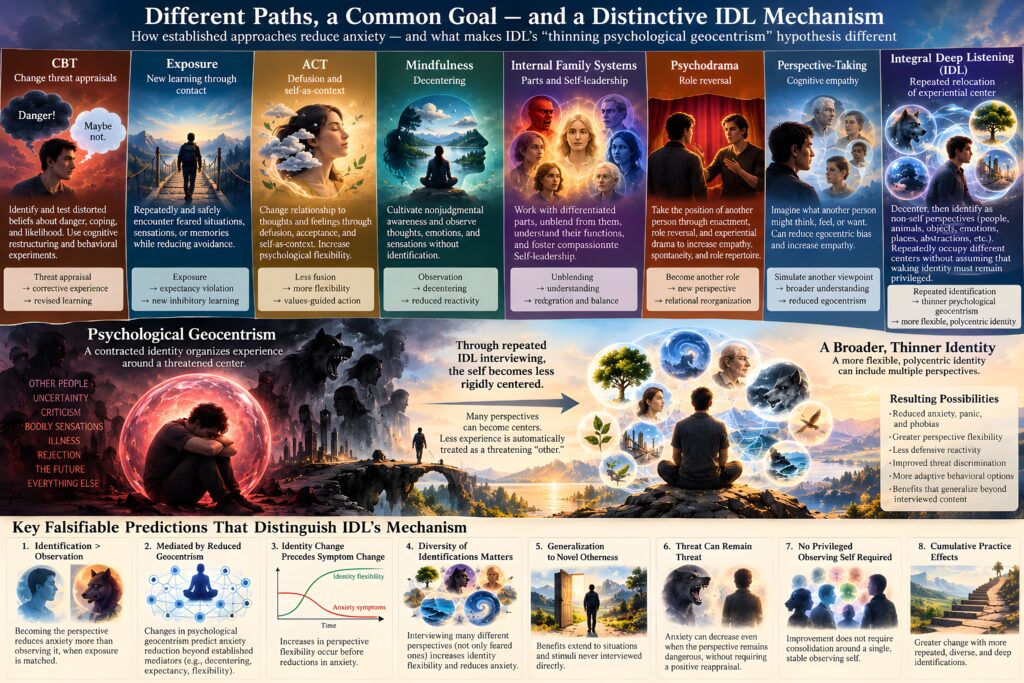
Integral Deep Listening overlaps with several established psychotherapeutic approaches. It uses exposure-like contact with feared material, resembles Acceptance and Commitment Therapy in loosening identification with thoughts and feelings, resembles mindfulness in decentering from ordinary experience, resembles Internal Family Systems in interviewing differentiated perspectives, resembles psychodrama in occupying other roles, and resembles perspective-taking interventions in deliberately shifting point of view.1
Because these similarities are substantial, IDL cannot establish a distinctive mechanism merely by showing that anxiety decreases after interviewing. Anxiety reduction could be explained by mechanisms already proposed by other approaches. The stronger question is therefore:
“What would have to occur for IDL’s hypothesis of “thinning psychological geocentrism” to add something that these existing mechanisms do not already explain?”
The answer lies in a specific claim. IDL proposes that repeated movement from waking identity into relatively autonomous non-self perspectives gradually reduces the exclusivity of waking identity as the psychological center from which experience is organized.2 Anxiety then decreases partly because experience is less rigidly divided between a vulnerable “me” and potentially threatening “others.”
That hypothesis overlaps with existing models but is not identical to any of them.
CBT and Exposure: Changing Threat Learning
The most obvious comparison is with cognitive-behavioral therapy and exposure. Traditional cognitive approaches to anxiety emphasize distorted threat appraisal.3 A person may overestimate danger, underestimate coping ability, catastrophically interpret bodily sensations, or assume that uncertainty predicts disaster. Cognitive restructuring attempts to test and modify these appraisals.
Exposure approaches work more behaviorally. The person repeatedly encounters feared situations, sensations, memories, or objects while reducing avoidance. Contemporary inhibitory-learning models emphasize that exposure need not erase the original fear association. Instead, new learning develops that competes with it.4 A person who expects, “If my heart races, I will collapse,” may repeatedly experience increased heart rate without collapse. Exposure works especially well when it violates threat expectancies across varied contexts rather than simply producing temporary habituation.5
The primary unit of change is therefore approximately: feared stimulus → anticipated catastrophe → corrective experience → revised threat learning
IDL may contain exposure.6 A person afraid of a dream monster, bodily sensation, public place, critical person, or panic itself may deliberately approach rather than avoid it during an interview. If anxiety falls afterward, exposure and expectancy violation could therefore explain some of the improvement.
IDL’s stronger hypothesis begins somewhere else. It asks what happens when the feared object is not merely approached but occupied as a center of experience. The sequence becomes:
I fear X → I decenter from “I” → I become X → from X, “I” becomes an object → I return with a less exclusive identification with the original center
Exposure predicts that repeated safe contact should weaken fear even if the person’s organization of identity does not substantially change.7 IDL predicts that a distinctive pathway should also be detectable: reductions in fear should be associated with increased capacity to move among experiential centers.
This is potentially a major distinction. CBT largely asks, “Is this dangerous?” IDL additionally asks, “Why must the threatened ‘me’ remain the only position from which this relationship is experienced?”
ACT: Cognitive Defusion and Self-as-Context
Acceptance and Commitment Therapy comes much closer to the IDL hypothesis. ACT does not primarily attempt to replace “irrational” thoughts with more rational ones. It changes one’s relationship to thoughts, emotions, and sensations. Cognitive defusion reduces literal identification with thought content.8 “I am going to lose control” becomes something closer to “I am noticing the thought that I am going to lose control.”
ACT’s concept of self-as-context is even more relevant.9 Instead of equating self with the changing contents of experience, ACT develops an observing perspective from which thoughts, emotions, roles, memories, and sensations can arise without defining the whole person. Psychological flexibility rather than symptom eradication is the broader objective.10
Acceptance- and mindfulness-based therapies show useful effects for anxiety, although mechanisms remain incompletely differentiated, and systematic reviews caution against assuming that any single proposed mediator has been uniquely established.
While IDL strongly overlaps with ACT in disidentification, the direction of movement differs.11
ACT commonly moves from: content → observing context
IDL typically moves from: one center → another center → another center → another center
ACT loosens attachment to the conceptualized self partly by cultivating a perspective from which multiple experiences can be observed. IDL loosens attachment by repeatedly surrendering the privilege of the waking perspective and becoming something that waking identity ordinarily experiences as not-self. This produces an important theoretical difference.
ACT could theoretically succeed if a person became extremely good at observing thoughts and feelings without fusion while retaining a relatively stable distinction between the observing perspective and everything observed.
IDL predicts that something additional happens when the person repeatedly occupies alternative centers. The distinction between “the perspective that observes” and “the perspectives observed” should itself become less hierarchical. IDL therefore does not simply propose: “I am more than my thoughts.” It proposes: “The “I” doing the observing is itself only one possible center of organization.”12
Whether that distinction has measurable consequences is exactly what research would need to determine.
Mindfulness and Decentering: Observing Without Identification
Mindfulness provides another close comparison. Decentering has been described as involving meta-awareness, disidentification from internal experience, and reduced reactivity to mental content.13 Changes in decentering have been associated with improvement in anxiety during mindfulness interventions, including research involving generalized anxiety disorder.14 Experimental work has also found that brief decentering instructions can reduce anxiety independently of experimentally manipulated expectations.
The basic movement can be represented as: “I am anxious” → “anxiety is occurring” → “I observe anxiety without becoming entirely identified with it.”
IDL accepts the value of this move but adds another:
“I am anxious” → “anxiety is occurring” → “I become Anxiety and experience the situation from its perspective.”
The difference can appear minor verbally while being substantial experientially.
Mindfulness normally reduces identification with an experience.15 IDL can reduce identification with waking identity by identifying as another experience. That is almost an inversion.
In mindfulness, one might observe the frightened child, angry critic, wolf, ocean, cancer, heart palpitation, or dream monster without becoming fused with it. In IDL one temporarily says, in effect: “I am now the wolf.” The person then responds to questions from that position. IDL therefore combines disidentification with reidentification.16
The hypothesis is that repeated reversible reidentification changes the structure of identity more deeply than observation alone because it repeatedly demonstrates that experience can organize coherently around centers other than the usual one.
This leads to an experimentally testable distinction. If mindfulness-style decentering and IDL produce equivalent reductions in anxiety, but only IDL produces measurable increases in the ability to inhabit autonomous alternative perspectives, and those changes independently predict later symptom reduction, the psychological-geocentrism hypothesis would gain support. If decentering alone explains all improvement, it would not.
Internal Family Systems: Multiplicity and Parts
Internal Family Systems is perhaps the closest conceptual neighbor to IDL because it explicitly treats the mind as multiple rather than unitary.
IFS assumes a multiplicity of “parts,” often understood as relatively differentiated internal systems possessing characteristic feelings, beliefs, roles, and intentions.17 Therapy involves “unblending” from parts, relating to them from qualities associated with Self, understanding their protective functions, and ultimately helping burdened or extreme parts assume less destructive roles.18 Contemporary reviews describe IFS as promising but still supported by a comparatively limited evidence base, with relatively few randomized trials. The similarity to IDL is real. Both approaches may ask a person to interact with an apparently autonomous internal perspective. Both can create distance from ordinary identification. Both take perspectives seriously rather than treating them merely as irrational symptoms.
However, the theoretical difference is fundamental. IFS begins with an ontology: “These are parts of an internal system.” It also assumes a privileged organizing principle: Self can become differentiated from parts and lead the internal system. IFS literature describes unblending so that Self can relate compassionately to parts and facilitate their transformation.
IDL deliberately suspends both assumptions.19 An interviewed dog, dead grandmother, tornado, cancer cell, chair, terrorist, river, dream monster, or anxiety may be a part of the self. It may also be useful to understand it in an entirely different way. IDL does not require a decision. More importantly, IDL does not assume that the waking person or a privileged inner Self should remain the final organizing center.
The difference can be summarized:
IFS: Parts become less blended so that Self can lead the system more effectively.
IDL: Waking identity repeatedly relinquishes centrality so that no single perspective is automatically granted permanent organizing privilege.
This creates a sharp falsifiable distinction. If anxiety improves because people simply develop a compassionate, stable observing center from which they relate to inner multiplicity, IFS and related models may explain the relevant mechanism perfectly well.
IDL predicts something more: the capacity to shift the center itself should matter independently of compassionate Self-leadership.20
The emerging IFS research program is particularly interesting here because investigators have already measured decentering, self-compassion, and emotion regulation as possible mechanisms. Those variables could therefore be directly compared with an IDL-specific measure of psychological geocentrism.
Psychodrama: Role Reversal and the Occupation of Another Center
Psychodrama creates another important precedent. Role reversal—the protagonist physically and psychologically taking the position of another person—is central to Morenian psychodrama.21 Psychodramatic work can also involve doubling, mirroring, and interaction with represented persons or objects. Contemporary reviews confirm that role reversal remains one of the most widely used psychodramatic techniques, although the research literature is methodologically heterogeneous. This looks remarkably similar to IDL identification. Indeed, of all the comparisons considered here, psychodrama may provide the strongest historical challenge to any claim that IDL invented the therapeutic occupation of another center.
IDL’s distinctive claim therefore cannot simply be: “Taking another role changes perspective.” Psychodrama has been doing that for generations. The difference lies instead in what is done with repeated role shifting and how the resulting perspective is conceptualized.
Psychodramatic role reversal is frequently embedded in a relational or interpersonal drama. One becomes one’s parent, partner, antagonist, or another role within an enacted scene. Its aims include empathy, spontaneity, interpersonal insight, role expansion, and reorganization of relational patterns.22
IDL generalizes the process beyond social roles. One may identify with:
- another person,
- an animal,
- a dream character,
- an inanimate object,
- a bodily symptom,
- an emotion,
- a place,
- an abstraction,
- a feared event,
- or something that has no obvious connection to one’s waking identity.23
The theoretical importance is that otherness itself, rather than merely interpersonal role-taking, becomes the training ground.
Psychodrama asks the participant to become another role.
IDL hypothesizes that repeated identification with sufficiently diverse centers gradually undermines the assumption that waking identity possesses privileged psychological centrality.
Research would therefore have to compare IDL not merely with passive controls, but with repeated psychodramatic role reversal. This is especially important because current psychodrama research does not yet permit strong technique-level conclusions; a recent meta-analysis found benefits against passive controls but no advantage against active controls and insufficient evidence to isolate specific psychodramatic techniques as causal mechanisms.
Perspective-Taking: Seeing From Another Point of View
Ordinary perspective-taking may appear to explain most of IDL without requiring new theory. People routinely ask: “What might she be thinking?” “How would this look to my child?” “What would my opponent say?” “What would I advise a friend in my situation?”
Such procedures can reduce egocentric bias and increase empathy,24 but IDL distinguishes thinking about another perspective from temporarily organizing experience as that perspective.25
The distinction is between, “What would the wolf think?” and,
“I am the wolf.” “What do I experience?” “What do I want?” “What do I think about Joseph?”
In conventional perspective-taking, the original self often remains implicitly in control. It generates a simulation of what another might think.
IDL attempts to weaken that control through epoché and identification. The participant is instructed to suspend assumptions and answer spontaneously from the alternative perspective, including when its responses contradict waking preferences.26 This produces another falsifiable comparison.
If simply imagining another viewpoint produces the same reduction in psychological geocentrism as full identification, IDL’s additional procedure may be unnecessary. If identification generates greater novelty, contradiction of waking assumptions, perceived autonomy, and later changes in identity flexibility than ordinary perspective-taking, IDL’s stronger mechanism becomes more plausible.
The Core Mechanistic Differences
The various approaches can therefore be differentiated by asking, What exactly is expected to change?
| Approach | Primary change process | Relationship to identity | What happens to the “other”? |
| CBT/cognitive therapy | Threat appraisal and beliefs become more accurate | Existing self evaluates cognition differently | Other becomes less dangerous |
| Exposure | New inhibitory/safety learning competes with fear | Existing self learns it can tolerate/approach threat | Other becomes less predictive of catastrophe |
| ACT | Defusion, acceptance, psychological flexibility, self-as-context | Self becomes less fused with content | Other is experienced without domination by avoidance |
| Mindfulness | Meta-awareness, decentering, nonreactivity | Self observes experience without identification | Other becomes an observed event |
| IFS | Unblending, compassionate Self-leadership, transformation of parts | Self differentiates from parts and leads them | Other is understood as a part within an internal system |
| Psychodrama | Role reversal, enactment, spontaneity, relational insight | Self temporarily assumes another role | Other becomes an enacted relational position |
| Perspective Taking | Cognitive simulation of another viewpoint | Existing self considers another standpoint | Other becomes cognitively represented |
| IDL | Repeated reversible relocation of experiential center | Waking identity loses exclusive centrality | Other temporarily becomes a center in its own right |
The IDL hypothesis therefore does not stand or fall on whether IDL shares mechanisms with these approaches. It almost certainly does. The important question is whether repeated relocation of experiential centrality explains additional variance in outcome after those established mechanisms are measured.
Specific Falsifiable Predictions
A useful theory must risk being wrong.27 “Thinning psychological geocentrism” becomes scientifically interesting only if it generates predictions that would not automatically follow from exposure, cognitive restructuring, acceptance, decentering, parts work, or ordinary perspective-taking.
Prediction 1: Identification Should Outperform Observation When Exposure Is Held Constant
Participants with the same feared stimulus could be randomly assigned to:
1. exposure to the stimulus,
2. mindful observation of the stimulus,
3. cognitive perspective-taking about the stimulus,
4. IDL identification as the stimulus.
Exposure duration, therapist contact, expectancy, and repetition would be matched.
IDL predicts that all groups may show reduced fear, but the IDL condition should produce larger changes in measures specifically assessing flexibility of experiential center and reduced psychological geocentrism.
If IDL improves anxiety but produces no distinctive identity change, the geocentrism hypothesis is weakened.
Prediction 2: Change in Psychological Geocentrism Should Mediate Anxiety Reduction
If IDL’s proposed mechanism is correct:
IDL participation → reduced psychological geocentrism → later reduction in anxiety
should be detectable longitudinally.
Importantly, change in psychological geocentrism should explain variance beyond:
- cognitive reappraisal,
- expectancy violation,
- decentering,
- acceptance,
- cognitive defusion,
- self-compassion,
- emotional regulation,
- and therapeutic alliance.
If established mediators fully explain IDL’s effects, there is little reason to posit a new mechanism.28
Prediction 3: Identity Change Should Precede Symptom Change
A causal mechanism should occur before the outcome it supposedly produces. Repeated IDL interviewing should therefore first produce measurable changes in:
- perspective flexibility,
- rigidity of self-identification,
- capacity to occupy discrepant perspectives,
- reduced privileging of waking identity,
- and tolerance of otherness.
Subsequent reductions in anxiety, panic, or avoidance should follow. If anxiety reduction consistently occurs first and identity change follows, thinning psychological geocentrism is more likely a consequence than a cause.29
Prediction 4: Diversity of Identifications Should Matter
Exposure theory primarily predicts benefit from learning concerning relevant feared stimuli. IDL predicts an additional effect from perspective diversity itself. For example, a person with panic disorder might interview:
- the racing heart,
- fear,
- a dream tornado,
- a chair,
- a wolf,
- a critical parent,
- an ocean,
- and a calm stranger.
If psychological geocentrism is being thinned through repeated relocation of experiential center, identification with perspectives that are not directly connected to panic should still increase identity flexibility and may indirectly reduce panic vulnerability. That would be difficult to explain purely as direct exposure to panic triggers.30
Prediction 5: Non-Self Identification Should Matter More Than Merely Talking to a Perspective
Participants could be assigned either to:
A. Dialogue condition: “Talk to the wolf.” or:
B. Identification condition: “Become the wolf and answer as the wolf.”
IDL predicts that B should produce greater change in psychological geocentrism than A. If the effects are identical, the distinctive role of occupying another center becomes doubtful.
Prediction 6: The Effect Should Generalize Across Content
If IDL only reduces fear of perspectives that have been explicitly interviewed, ordinary exposure or cognitive learning could explain the result, but if the mechanism involves identity structure, repeated interviewing should generate cross-domain transfer. Someone who has interviewed many unrelated perspectives should become less reactive to a novel “other” never encountered during interviewing.
For example, after weeks of IDL involving dream figures and life issues, a participant might show reduced defensive responding to unfamiliar social disagreement, uncertainty, bodily sensations, or ambiguous threat. Generalization would support a structural identity mechanism.31
Prediction 7: IDL Should Increase Tolerance of Contradictory Perspectives
Psychological geocentrism implies privileging interpretations compatible with the existing identity. Thinning should therefore increase the ability to entertain perspectives that contradict one’s beliefs, preferences, and self-description without immediately rejecting or assimilating them. IDL participants should show increasing capacity to report:
“I strongly disagree with this perspective, but I can nevertheless inhabit it accurately.”
This should distinguish thinning geocentrism from simple self-esteem enhancement, reassurance, or relaxation.
Prediction 8: Helpful Interviews Should Not Require the Alternative Perspective to Become Friendly
Exposure and reassurance might lead us to predict that anxiety falls when feared things become perceived as safer. IDL predicts something more interesting. A feared perspective may remain hostile, dangerous, critical, or unwanted while producing reduced anxiety if the participant becomes less exclusively organized around the threatened self.
Thus: reduced fear should not require positive reevaluation of the other.
A wolf can remain dangerous. A critic can remain critical. Death can remain death. What changes is the rigidity of the relationship between center and other. If improvement occurs only when threatening perspectives are reconceptualized as benevolent, supportive, or safe, ordinary cognitive reappraisal may explain the change better.32
Prediction 9: A Stable Observing Self Should Not Be Necessary
ACT and IFS provide different versions of a stable organizing standpoint—self-as-context in ACT and Self in IFS.
IDL predicts that improvement does not require consolidation around a privileged internal observer or Self. Participants who become better at shifting centers without privileging any one of them should improve even if their sense of a stable central observer does not increase.
If improved functioning consistently depends upon strengthening a central observing Self, ACT or IFS may provide a more parsimonious explanation.
Prediction 10: “Parts” Ontology Should Not Be Necessary
Participants could receive identical interviewing procedures with different framings:
Group A: “This is a part of you.”
Group B: “We do not know what this perspective is. Let us interview it without deciding.”
If IDL’s indefinite ontology matters, Group B should show equal or greater novelty, autonomy of responses, contradiction of waking assumptions, and perhaps stronger changes in psychological geocentrism. If explicit parts framing performs equally or better across all relevant measures, indefinite ontology may not contribute much mechanistically.
Prediction 11: Surprise Should Be a Mechanistic Variable
IDL repeatedly emphasizes that alternative perspectives sometimes generate responses waking identity did not anticipate. If psychological geocentrism restricts what the current identity can generate, then surprise should have theoretical importance. Interviews producing greater amounts of credible, relevant, unexpected material should predict larger subsequent changes in identity organization than interviews that merely reproduce the person’s existing beliefs. This yields a measurable variable:
degree of discrepancy between predicted perspective responses and actual reported responses.
If surprise bears no relationship to later change, the claim that IDL accesses relatively independent perspectives becomes less consequential.33
Prediction 12: Perspective Autonomy Should Increase With Practice
Repeated IDL interviewees often report that alternative perspectives seem easier to access and less controlled by deliberate waking construction. If this is genuine rather than expectancy or practice in imaginative fluency, longitudinal measures should show:
- faster access to alternative perspectives,
- greater internal consistency within perspectives,
- more disagreement with waking identity,
- more novel responses,
- and less conscious effort required to generate them.
These changes should correlate with reduced psychological geocentrism.
Prediction 13: Perspective Breadth Should Predict Resilience Better Than Number of Insights
If IDL is primarily an insight therapy, people who accumulate more personally meaningful insights should improve most. If the geocentrism hypothesis is correct, breadth and reversibility of identification should predict outcomes independently of the number of insights reported.
Someone who learns little that feels profound but becomes highly skilled at shifting among perspectives may eventually show more durable reductions in defensive reactivity than someone who has several dramatic insights but remains strongly centered in the original identity.
Prediction 14: Effects Should Extend Beyond Anxiety
This is one of the most important predictions. If thinning psychological geocentrism is genuinely a structural change in identity rather than simply a method for reducing anxiety, its effects should appear elsewhere. Repeated interviewing should also reduce:
- personalization,
- cognitive fusion,
- defensive reactivity,
- rigid interpersonal attribution,
- overidentification with transient moods,
- intolerance of disagreement,
- and automatic self/other polarization.
It should increase:
- perspective flexibility,
- cognitive and emotional differentiation,
- capacity for self-distancing,
- tolerance for ambiguity,
- and ability to revise self-concepts.
If the effect is limited narrowly to the symptom that was interviewed, exposure or symptom-specific learning becomes a more economical explanation.
Prediction 15: IDL Should Produce a Distinct Dose-Response Curve
IDL predicts cumulative changes from repeated center-shifting. The relevant “dose” should therefore not simply be number of therapy hours. It should be approximately:
number × diversity × depth of successful perspective identifications
A hundred interviews involving genuine shifts of center should theoretically produce more thinning of psychological geocentrism than five powerful interviews, even if the five produce substantial immediate reframings.
If there is no cumulative relationship between repeated identification and identity flexibility, one of IDL’s central assumptions is weakened.34
Prediction 16: Benefits Should Survive Withdrawal of the Interviewing Procedure
A structural change should increasingly become trait-like. Early in training, a person may need the formal IDL protocol to shift perspective. Later, the person should spontaneously exhibit greater decentering and less defensive identification during ordinary life without consciously performing an interview.
Thus repeated IDL should eventually alter baseline responding. If improvements occur only while interviewing and disappear when the procedure stops, the hypothesis of durable thinning is weakened.
Prediction 17: Physiological Threat Reactivity May Change Without Explicit Cognitive Reappraisal
If the person reorganizes the self/other relationship rather than merely changing conscious beliefs, physiological threat responses may diminish even when explicit danger estimates remain relatively unchanged. For example, someone could continue to rate a situation as objectively risky yet show:
- lower anticipatory arousal,
- less avoidance,
- faster physiological recovery,
- and greater behavioral flexibility.
That pattern would be difficult to explain solely through positive thinking or reassurance.
Prediction 18: IDL Should Differ Most Strongly From Other Approaches at High Levels of “Otherness”
The clearest test of IDL may not involve ordinary social role-taking. Its distinctive effects should become most visible when participants identify with perspectives that waking identity regards as maximally unlike itself:
- feared enemies,
- disgusting objects,
- threatening animals,
- painful bodily symptoms,
- death,
- impersonal objects,
- dream figures,
- abstract processes,
- or perspectives that strongly contradict personal values.
The theory predicts that skill in occupying such highly discrepant perspectives should be particularly associated with thinning psychological geocentrism. If identification works only when the other is already psychologically similar to the participant, ordinary empathy or perspective-taking may be sufficient to explain the results.
The Critical Experiment
A particularly informative study could directly compare four active conditions:
Exposure: remain yourself and approach the feared object.
Mindful decentering: remain aware of the feared object and your reactions without identifying with either.
Perspective-taking: imagine what the feared object or person might experience.
IDL identification: become the object or perspective and answer structured questions from its point of view.
All conditions would be matched for duration, therapist attention, repetition, expectancy, and degree of contact with feared material. Researchers would measure anxiety symptoms together with:
- behavioral avoidance,
- physiological threat responses,
- threat expectancy,
- cognitive defusion,
- decentering,
- psychological flexibility,
- self-compassion,
- perspective-taking,
- self-concept clarity,
- perceived autonomy of alternative perspectives,
- flexibility of experiential center,
- and a newly validated measure of psychological geocentrism.
The decisive question would not simply be: Which group became less anxious? It would be: Does IDL produce a distinctive change in the organization of identity, and does that change explain subsequent reductions in anxiety beyond the mechanisms already identified by established therapies?35 That is the empirical burden created by the theory.
What Would Count Against the Theory?
Several results should be accepted as serious challenges rather than explained away. The hypothesis would be weakened if:
- IDL reduces anxiety no more than matched exposure and produces no distinctive identity changes.
- Decentering entirely mediates IDL outcomes, leaving psychological geocentrism with no independent explanatory contribution.
- Ordinary perspective-taking produces the same effects as full identification.
- Treating alternative perspectives explicitly as “parts” works just as well as indefinite ontology.
- Increased ability to shift perspectives does not predict anxiety reduction.
- Identity flexibility follows symptom improvement rather than preceding it.
- Interview diversity has no relationship to outcomes.
- IDL effects remain limited to material directly rehearsed during interviews.
- repeated interviewing produces insights but no durable changes in spontaneous self/other organization.
Those would not demonstrate that IDL is useless. They would mean that its clinical effects are probably better explained by mechanisms already present in other therapeutic traditions.
What Would Count as Distinctive Support?
The strongest evidence for the IDL model would instead look something like this:
Repeated IDL identification reliably increases the ability to relocate experiential center; this change occurs before symptom reduction; it predicts anxiety reduction after exposure learning, decentering, defusion, acceptance, self-compassion, alliance, and expectancy are statistically controlled; it generalizes to novel forms of otherness; and the magnitude of change depends upon the diversity and depth of repeated non-self identification.
That would support the proposition that IDL is doing something more than teaching relaxation, correcting irrational beliefs, exposing people to fear, encouraging acceptance, cultivating an observing self, dialoguing with parts, or practicing empathy. It would suggest that repeated interviewing changes something more fundamental: the degree to which waking identity experiences itself as the unquestioned center of psychological reality.
The distinctive IDL hypothesis can therefore be stated precisely: Anxiety is maintained in part by a recursively defended organization of identity in which waking self is experienced as the privileged center and increasing domains of experience are organized as potentially threatening otherness. Repeated IDL identification weakens this organization by making alternative perspectives temporary centers of experience. Over time, this produces a broader, thinner, more polycentric identity in which less experience is automatically organized as threatening “not-self.” Reduced anxiety is one predicted consequence of that reorganization.
The significance of the hypothesis is not that other therapies fail to decenter identity. Several clearly do. The stronger claim is that decentering may be only half of the process. IDL adds repeated recentering elsewhere. Its most distinctive empirical question becomes:
Does repeatedly ceasing to be the center change anxiety in ways that merely observing, accepting, challenging, approaching, or empathizing with the other does not?
The comparison is especially strong against ACT, mindfulness, IFS, and psychodrama because those approaches prevent IDL from claiming distinctiveness merely from “decentering,” “multiplicity,” or “role reversal.” The scientifically interesting claim is narrower: IDL repeatedly relocates the center rather than merely distancing from its contents, and the cumulative effect of that relocation is hypothesized to thin the privileged status of waking identity.
Notes
1. Overlapping mechanisms do not imply identical theories.
IDL shares procedures or proposed mechanisms with several established therapeutic traditions. CBT uses cognitive restructuring and behavioral experiments; exposure therapy repeatedly contacts feared stimuli or sensations; ACT emphasizes acceptance, defusion, psychological flexibility, and self-as-context; mindfulness approaches cultivate nonjudgmental awareness and decentering; IFS works with differentiated internal “parts”; psychodrama uses role-taking and role reversal; and perspective-taking research examines movement beyond one’s habitual viewpoint. The existence of these overlaps makes an important methodological point: evidence that IDL reduces anxiety would not by itself establish a distinctive IDL mechanism. Mechanism research must determine why change occurs.
Barlow, D. H. (Ed.). (2021). Clinical Handbook of Psychological Disorders (6th ed.). Guilford Press.
Hayes, S. C., Strosahl, K. D., & Wilson, K. G. (2012). Acceptance and Commitment Therapy (2nd ed.). Guilford Press.
Bernstein, A., et al. (2015). Decentering and related constructs. Perspectives on Psychological Science, 10, 599–617.
Schwartz, R. C., & Sweezy, M. (2020). Internal Family Systems Therapy (2nd ed.). Guilford Press.
Moreno, J. L. (1946/1985). Psychodrama, First Volume. Beacon House.
2. “Psychological geocentrism” is an IDL construct
Psychological geocentrism refers to the tendency for waking identity to experience itself as the implicit center from which other people, emotions, thoughts, bodily states, dream images, and environmental events are evaluated. The stronger claim that repeated identification with alternative centers “thins” psychological geocentrism is an IDL hypothesis rather than an established psychological mechanism. It has conceptual relatives in decentering, self-distancing, psychological flexibility, metacognitive awareness, and self-as-context, but should not be treated as synonymous with any of them. Its scientific usefulness depends upon operationalizing it independently enough to determine whether it explains variance beyond those established constructs.
3. Cognitive theories of anxiety and threat appraisal
Cognitive models propose that anxiety disorders are maintained partly through biased appraisals of danger, vulnerability, coping resources, and the significance of bodily or mental events. Panic provides a particularly clear example: benign bodily sensations may be catastrophically interpreted, producing additional arousal that appears to confirm the original interpretation. Generalized anxiety similarly involves patterns of threat anticipation, worry, and intolerance of uncertainty. IDL need not reject these models; its hypothesis attempts to locate them within a broader organization of self-versus-other.
Beck, A. T., Emery, G., & Greenberg, R. L. (1985). Anxiety Disorders and Phobias: A Cognitive Perspective. Basic Books.
Clark, D. M. (1986). A cognitive approach to panic. Behaviour Research and Therapy, 24, 461–470.
Dugas, M. J., et al. (1998). Generalized anxiety disorder: A preliminary test of a conceptual model. Behaviour Research and Therapy, 36, 215–226.
4. Exposure and inhibitory learning
Contemporary exposure theory has moved beyond a simple model in which fear must gradually habituate or be erased. Inhibitory-learning accounts propose that exposure creates new associations that compete with previously learned threat associations. A person may retain the capacity for fear while learning that the feared stimulus does not reliably predict the anticipated catastrophe.
Craske, M. G., Treanor, M., Conway, C. C., Zbozinek, T. D., & Vervliet, B. (2014). Maximizing exposure therapy: An inhibitory learning approach. Behaviour Research and Therapy, 58, 10–23.
5. Expectancy violation
One implication of inhibitory-learning models is that exposure can be strengthened by violating expectancies rather than merely waiting until anxiety subsides. Varying contexts, stimuli, and conditions may improve retrieval of competing non-threat associations. This provides an important competing explanation for IDL: an interview in which a feared object behaves differently from expectation may constitute an expectancy violation even if no distinctive change in identity occurs.
Craske, M. G., et al. (2014). Maximizing exposure therapy. Behaviour Research and Therapy, 58, 10–23.
Craske, M. G., Hermans, D., & Vervliet, B. (2018). State-of-the-art and future directions for extinction as a translational model for fear and anxiety. Philosophical Transactions of the Royal Society B, 373, 20170025.
6. IDL interviews may contain exposure
When a person identifies with a feared dream character, bodily sensation, panic, antagonist, or phobic object, the procedure necessarily involves approaching material that might otherwise be avoided. Consequently, some improvement associated with IDL could result from exposure, reduction of avoidance, expectancy violation, or new learning. A rigorous comparison should therefore use an exposure condition matched for duration and intensity rather than a no-treatment control alone.
7. Exposure does not require a theory of identity reorganization
Exposure theory can explain fear reduction without assuming that the person’s basic organization of identity has changed. This creates an important discriminating test for IDL. If reductions in fear are fully predicted by exposure variables while measures of psychological geocentrism add nothing, the simpler exposure explanation should be preferred.
8. Cognitive defusion
ACT describes cognitive fusion as excessive domination of behavior by verbal or cognitive content. Defusion procedures attempt to change the functional relationship to thoughts rather than prove them true or false. A thought such as “I cannot tolerate this” can remain present without functioning as an unquestioned command or description of reality.
Hayes, S. C., Strosahl, K. D., & Wilson, K. G. (2012). Acceptance and Commitment Therapy. Guilford Press.
Hayes, S. C., Luoma, J. B., Bond, F. W., Masuda, A., & Lillis, J. (2006). Acceptance and Commitment Therapy: Model, processes and outcomes. Behaviour Research and Therapy, 44, 1–25.
9. Self-as-context
Self-as-context refers to a flexible perspective from which changing thoughts, emotions, memories, sensations, and self-descriptions can be experienced without equating the whole self with any particular content. It is therefore especially relevant to IDL’s account. However, IDL proposes an additional movement: rather than only differentiating observing perspective from content, it repeatedly reorganizes experience around perspectives ordinarily classified as “other.”
Hayes, S. C., et al. (2012). Acceptance and Commitment Therapy.
Godbee, M., & Kangas, M. (2020). The relationship between flexible perspective taking and emotional well-being: A systematic review of the “self-as-context” component of ACT. Behavior Therapy, 51, 917–932.
10. Psychological flexibility
Psychological flexibility is a central ACT construct involving openness to experience, flexible attention to the present, and behavior organized around chosen values rather than rigid avoidance or cognitive fusion. It is broader than anxiety reduction. Because psychological flexibility could plausibly explain improvements following IDL, any test of psychological geocentrism should measure it rather than assuming that the two constructs are different.
Hayes, S. C., et al. (2006). Acceptance and Commitment Therapy: Model, processes and outcomes. Behaviour Research and Therapy, 44, 1–25.
11. IDL and ACT may share disidentification mechanisms
Both ACT and IDL reduce the automatic equation of transient psychological content with identity. The empirical question is not whether this overlap exists, but whether repeated identification as another center contributes anything after defusion, acceptance, and self-as-context have been measured.
12. From observing context to multiple centers
This is a specifically IDL theoretical distinction. IDL does not deny the usefulness of an observing perspective but questions whether it must become the final privileged center. Repeated identification with dream figures, objects, bodily processes, animals, or other perspectives creates the hypothesis that experiential centrality itself can become more flexible. Evidence for ACT’s self-as-context does not by itself validate this stronger proposition.
13. Decentering
Decentering is generally characterized by meta-awareness of subjective experience, reduced identification with mental content, and reduced reactivity to that content. Related constructs include reperceiving, cognitive distancing, metacognitive awareness, and defusion. The overlap among these constructs is itself a reason to operationalize IDL terminology carefully.
Bernstein, A., Hadash, Y., Lichtash, Y., Tanay, G., Shepherd, K., & Fresco, D. M. (2015). Decentering and related constructs: A critical review and metacognitive processes model. Perspectives on Psychological Science, 10, 599–617.
14. Decentering as a possible mechanism of therapeutic change
Research has investigated decentering as a mediator or mechanism within mindfulness- and acceptance-based treatments. Evidence suggests that changes in decentering can accompany improvements in psychological symptoms, although mediation research does not establish that decentering uniquely accounts for all therapeutic effects.
Bernstein, A., et al. (2015). Decentering and related constructs.
Johannsen, M., et al. (2022). Mediators of acceptance and mindfulness-based therapies for anxiety and depression: A systematic review and meta-analysis. Clinical Psychology Review, 94, 102156.
15. Observation versus identification
The contrast between mindfulness and IDL should not be overstated. Mindfulness traditions are diverse, and some contemplative practices substantially destabilize ordinary assumptions about selfhood. The narrower comparison here concerns standard clinical decentering procedures in which experiences are observed without fusion. IDL’s distinctive procedural hypothesis is that temporarily becoming another perspective adds something beyond observing it.
16. Disidentification followed by reidentification
“Reidentification” is useful for describing the IDL sequence but is not presented here as an established therapeutic mechanism. The proposed sequence is:
identification with waking self → decentering → identification as other → return without necessarily restoring the original organization unchanged.
Research could directly compare this sequence with decentering alone.
17. IFS and psychological multiplicity
IFS explicitly conceptualizes the psyche as containing differentiated parts with characteristic intentions, emotions, burdens, and protective functions. It is therefore particularly relevant to IDL because both approaches take apparently autonomous internal perspectives seriously.
Schwartz, R. C., & Sweezy, M. (2020). Internal Family Systems Therapy (2nd ed.). Guilford Press.
18. Unblending and Self-leadership
In IFS, therapeutic work commonly involves “unblending” from a part so that it can be approached from Self, which is associated within the model with qualities such as curiosity, compassion, calmness, and clarity. Parts are not simply eliminated; their protective intentions can be understood and their burdens transformed. IDL differs by declining to assume either that the interviewed perspective is a part or that a privileged Self should constitute the final organizing center.
Schwartz, R. C., & Sweezy, M. (2020). Internal Family Systems Therapy.
19. Indefinite ontology
IDL’s “indefinite ontology” is a methodological commitment to postponing conclusions regarding what an interviewed perspective ultimately is. A dream monster may be treated phenomenologically as a perspective without deciding whether it is a part, archetype, neural construction, internalized relationship, imaginative simulation, emergent organization, or something else. The empirical question is whether this suspension of ontological assumptions produces more novelty, less suggestion, greater perceived autonomy, or different outcomes than explicit parts framing.
20. Self-leadership versus polycentricity
This distinction provides a particularly useful comparison between IDL and IFS. If outcomes are best predicted by increasing access to a compassionate central Self, IFS offers a parsimonious explanation. If the ability to move flexibly among centers predicts outcomes independently of Self-leadership and self-compassion, the IDL hypothesis receives more distinctive support.
21. Moreno and role reversal
Role reversal is foundational to psychodrama. Participants can physically take another person’s position and speak from that role, thereby encountering a relationship from a different experiential location. Consequently, IDL cannot plausibly claim that becoming another perspective is itself unprecedented.
Moreno, J. L. (1946/1985). Psychodrama, First Volume. Beacon House.
Kellermann, P. F. (1992). Focus on Psychodrama: The Therapeutic Aspects of Psychodrama. Jessica Kingsley.
22. Spontaneity, role repertoire, and relational reorganization
Moreno viewed spontaneity and creativity as central to adaptive functioning, and psychodrama seeks to expand the repertoire of roles available to a person rather than leaving them trapped in repetitive relational patterns. This creates significant conceptual overlap with ART’s interest in expanding adaptive possibilities. IDL’s proposed distinction lies less in role reversal itself than in the systematic use of non-social and dream-generated perspectives and in its theory of cumulative decentralization of identity.
23. Beyond interpersonal roles
IDL interviews can involve people but also animals, objects, places, emotions, bodily symptoms, dream images, abstractions, or other imagined perspectives. The theoretical claim is that sufficiently diverse identifications may train a general capacity for relocation of experiential center rather than merely improve understanding of specific interpersonal roles. This remains a testable hypothesis.
24. Perspective-taking and egocentric bias
Social-cognitive research distinguishes one’s own perspective from representations of other people’s mental states. Perspective-taking can improve interpersonal understanding and sometimes reduce egocentric judgment, although effects depend on context and successful perspective-taking can also be biased by projection of one’s own assumptions onto others.
Davis, M. H. (1983). Measuring individual differences in empathy: Evidence for a multidimensional approach. Journal of Personality and Social Psychology, 44, 113–126.
Epley, N., Keysar, B., Van Boven, L., & Gilovich, T. (2004). Perspective taking as egocentric anchoring and adjustment. Journal of Personality and Social Psychology, 87, 327–339.
25. Imagining another versus becoming another
The distinction between cognitively representing another viewpoint and temporarily identifying as that viewpoint is central to the proposed IDL mechanism. However, this distinction should be demonstrated empirically rather than assumed. A useful experiment would compare matched instructions to “imagine what X thinks” and “become X and answer as X,” while measuring novelty, perceived autonomy, disagreement with waking assumptions, and subsequent identity flexibility.
26. Epoché and reduction of top-down interpretation
IDL uses epoché in the phenomenological sense of temporarily suspending habitual judgments and assumptions. The methodological objective is to reduce the extent to which waking identity determines beforehand what an interviewed perspective is supposed to say. This use is inspired by phenomenological suspension but should not be equated with Husserl’s entire philosophical project.
Husserl, E. (1913/1982). Ideas Pertaining to a Pure Phenomenology and to a Phenomenological Philosophy, First Book (F. Kersten, Trans.). Martinus Nijhoff.
27. Falsifiability
The demand that a theoretical explanation expose itself to possible disconfirmation is closely associated with Popper, although contemporary philosophy of science provides considerably more nuanced accounts of theory testing than simple single-experiment falsification. Here the principle is pragmatic: psychological geocentrism becomes scientifically useful only if observations can be specified that would make the proposed mechanism less plausible.
Popper, K. R. (1959). The Logic of Scientific Discovery. Hutchinson.
28. Incremental explanatory validity
Showing that psychological geocentrism correlates with anxiety would be insufficient. To justify introducing a new construct, it should ideally demonstrate incremental validity: predicting theoretically relevant outcomes after established constructs such as decentering, experiential avoidance, cognitive fusion, psychological flexibility, self-compassion, threat expectancy, and therapeutic alliance have been considered. Otherwise the new terminology risks redescribing mechanisms already adequately measured under other names.
29. Temporal precedence
Mediation claims are stronger when changes in the proposed mechanism precede changes in outcome. Cross-sectional correlations cannot establish whether reduced psychological geocentrism causes reduced anxiety, anxiety reduction permits greater perspective flexibility, or a third process produces both. Repeated measurement during treatment would therefore be preferable to simple pre/post assessment.
Kazdin, A. E. (2007). Mediators and mechanisms of change in psychotherapy research. Annual Review of Clinical Psychology, 3, 1–27.
30. Content-independent change
This prediction is particularly important because it differentiates structural reorganization from stimulus-specific learning. If interviewing a chair, tree, dream figure, animal, or unrelated person eventually reduces reactivity to panic sensations that were never directly interviewed, a broader mechanism becomes more plausible. Such results would still require alternative explanations—including generalized psychological flexibility—to be tested.
31. Generalization as evidence for structural change
Transfer to novel situations is stronger evidence for a general capacity than improvement restricted to practiced material. IDL therefore predicts that increasing flexibility of experiential center should generalize beyond the specific interview content. The critical comparison would be whether such generalization exceeds that produced by exposure, mindfulness, ACT, or conventional perspective-taking.
32. Threat can remain threat
IDL does not predict that adaptive change requires converting every threatening perspective into a friendly one. This distinguishes the hypothesis from simple reassurance or positive reappraisal. Adaptive functioning requires accurate recognition of genuine danger. If anxiety reduction can occur while participants continue to judge an objectively dangerous stimulus as dangerous, but relate to it with less defensive identity contraction, that pattern would fit the proposed mechanism particularly well.
33. Surprise as a potential measure of relative autonomy
IDL’s concept of relatively autonomous perspectives creates an unusual empirical opportunity. Before an interview, participants could predict how they expect the selected perspective to answer standardized questions. Predictions could then be compared with actual responses. Discrepancy, relevance, internal coherence, and subsequent usefulness could be independently rated. If repeated interviews merely reproduce anticipated waking beliefs, the claim that the procedure accesses meaningfully differentiated perspectives would be weakened. Surprise alone, however, is insufficient: random or incoherent responses can also be surprising.
34. A distinctive dose hypothesis
If repeated relocation of experiential center gradually thins psychological geocentrism, IDL predicts a cumulative relationship between practice and identity flexibility. The relevant dose may involve not merely the number of interviews but their frequency, diversity, depth of identification, degree of discrepancy from waking assumptions, and behavioral application. This prediction distinguishes the theory from explanations in which one powerful corrective insight is sufficient.
35. Mechanism rather than brand comparison
The most informative research would not simply ask whether “IDL works better than CBT,” ACT, mindfulness, IFS, or psychodrama. Such comparisons confound numerous variables. A stronger design dismantles the procedures into candidate mechanisms: exposure, expectancy violation, observation, defusion, perspective-taking, identification, role reversal, ontological framing, and repeated relocation of experiential center. This allows the distinctive IDL proposition to be tested without requiring one entire therapeutic school to “defeat” another.