
Life Issue Interviewing 102: The function of interviewing questions
[/col] [/row] [/section] [section] [row style=”small” v_align=”equal”] [col span__sm=”12″ class=”what-idl-sec2″]Life Issue Interviewing 102: The function of interviewing questions
In this unit you will learn why…
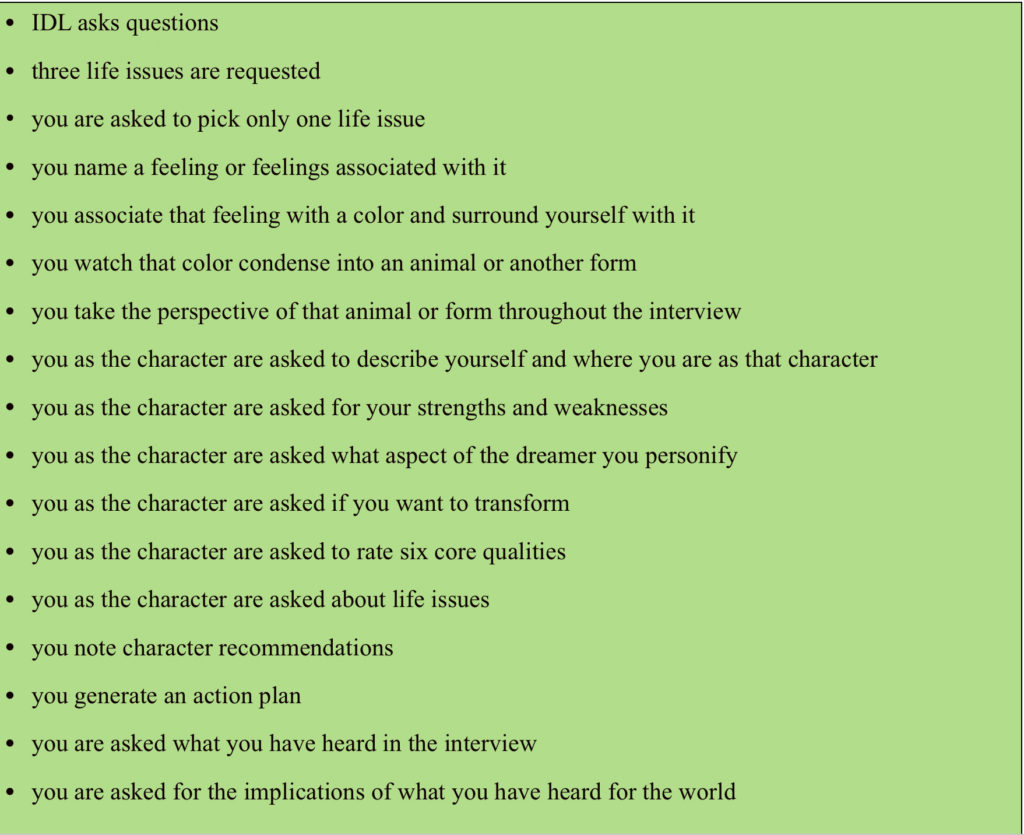
Why IDL asks questions
Integral Deep Listening interviewing is built around asking questions. Why? There are other common alternatives to asking questions, including observation and drawing conclusions, analysis, interpretation, and experiential interaction. While questioning is foundational to the medical model, in the process of gathering a history, that questioning is used to arrive at a diagnosis and then to construct a treatment plan. That is not how or why IDL asks questions.
Asking questions accesses additional information. That information clarifies, corrects misunderstandings, challenges or confirms assumptions and interpretations, It puts the questioner in a receptive, responsive mode rather than in a powerful, confident, and reactive mode. Questioning reflects a higher order confidence based on not needing to assume or pretend we know what is best for another person or even for ourselves. It puts us in an open and receptive space, which is phenomenological. In it we can suspend our assumptions and interpretations in order to challenge or confirm them with more information.
In this way, questioning is also a way of testing our assumptions, interpretations, and hypotheses about why we or others are stuck. The more information we can gain from multiple sources regarding why we may be stuck, the more likely we are to arrive at a realistic and useful way forward. And clearly, perspectives that know us at least as well as we know ourselves, because they are innately and authentically our own, are likely to provide relevant information that may prove surprisingly creative because it reflects worldviews and perspectives that we either do not share or have not considered.
Who is most likely to know both the source and solution to a problem?
Our answers to our life issues reflect our waking perspective. However, there are other perspectives that are relevant. There are those of objective experts and information sources. There are those accessed through altered states of consciousness such as mystical or drug-induced experiences. By becoming dream characters and the personifications of life issues we access non-waking perspectives that not only have opinions about how and why we have the life issues we do, but often provide creative solutions, diagnoses, and “treatment plans.”
The normal approach is to provide treatment based on what has worked for others presenting similar symptoms. That is a clear path forward with physical heath issues and even with some mental health issues, but then there are multiple reasons why a tried and true solution does not work for this or that particular client. Why not?
Just as important is who or what is questioned. Most approaches to questioning interrogate the client, patient, or subject, based on the assumption that they have the problem, medical or psychological, that they want to make go away. They are the customer and you are the service provider. IDL questions such assumptions as part of its questioning process. Yes, it is true that clients come to you because they have some problem they want to have fixed. However, what if they lack the information necessary to reach a diagnosis and prescribe treatment?
IDL questioning has some similarities to the Socratic dialectic, in which incorrect premises and assumptions are surfaced and challenged. However, unlike the Socratic dialectic and most other approaches to questioning, IDL does not direct its questions primarily at the patient or client. This is because IDL assumes that if we knew the answers consciously we would meet with more success at getting unstuck. However, we have resistances to applying what we know and require support and structure. Habits and addictions often work at cross-purposes to out conscious intentions and knowledge. Freud’s defense mechanisms provide a useful outline of important ways we can sabotage treatment, as well as our health, self-development, and best intentions.
Questioning subjective sources of objectivity
IDL questioning accesses interior source of objectivity provided by non-waking perspectives that are accessed through inducing a light “altered state.” This is achieved by simply disidentifying with your normal waking perspective and becoming, embodying, identifying with, or experiencing yourself as looking out at life from the perspective of a dream, fictional, historic, or mystical character or element or the personification of a life issue, and then answering questions designed to access different authentic and relevant perspectives on how and why one is stuck and what might best be done about it.
These perspectives are not necessarily superior or “right;” they are imaginary, and their interpretations and perspectives must be assessed as to their relevance and pragmatic value. Are they reasonable? Can they be operationalized? Can they be safely implemented in a way that tests their validity and usefulness? When that is done does one’s life issue move toward resolution or not?
Interviewing as one aspect of a multi-perspectival approach
IDL interviewing is therefore only one tool in a multi-pronged approach IDL uses to approach healing, balancing, and transformation. As explained in the problem solving module, we require objective and waking sources of input and that, combined with our own experience, common sense, and intuition is often enough to resolve many life issues. However, just as “two heads are better than one” at problem solving, so “three heads are better than two.” When consultation of objective “expert” sources is combined with common sense and interior and subjective sources of objectivity are also consulted, the accessing of three different informational domains is more likely to yield a workable solution than accessing just one or two.
The feedback we receive from interviewed characters is often nothing new. It is normal that IDL interviewing is met with the comment or thought, “I already knew that.” That is indeed true, because if information comes from perspectives that are innately your own, then on some level you are simply hearing something you already know. However, hearing new things is not the purpose or function of IDL interviewing. It is not primarily about insight or revelatory knowledge. Rather, it is about considering how your life might be if you approached it and your life issues from a different set of priorities. You have your goals and priorities but you may be blocked or stuck in moving forward toward them. Why? Could it be because your priorities are not aligned with those that want to be expressed, to be born into your waking awareness and acted upon?
Most of us are working at cross-purposes to authentic, innate emerging potentials that have their own priorities that are surfacing in our dreams and life in hunches and unexpected spontaneous thoughts and feelings. IDL interviewing is a way to learn to listen to them in a deep and integrative way.
Why three life issues are requested
There will be times when one issue is so immediate and intense that other issues fade in significance. By all means, focus on that. However, even in such circumstances it makes sense to ask for a couple more life issues. This is because helpful information about issues that are not on the front burner is often provided by interviewed characters.
Asking for three life issues often turns up an underlying issue that is not so pressing but supports and helps maintain more immediate issues.
Why you are asked to pick only one life issue
Picking one life issue provides a focus for the interview in terms of the identification of one character to interview. As noted above, it may well give helpful input about the other issues.
Why you name a feeling or feelings associated with it
Accessing feeling states gets us out of the abstractions of our thoughts and into a level of awareness that is much closer to the consciousness of the dream state and the intentions that generate dreams. Similarly, our life issues have important, often poorly recognized or understood, emotional roots. Accessing our feelings about an issue help us turn the issue into a form to interview.
Why you associate that feeling with a color and surround yourself with it
This mimics the creation of dreams by giving intentions and feelings form.
Why you watch that color condense into an animal or another form
Just as in your dreams images condense into interactive scenarios, so stepping back and allowing feelings and colors take whatever shape they want to provides opportunities for innate creative processes intrinsically related to your intentions, feelings, and life issues, to manifest as some representative form.
Why you take the perspective of that animal or form throughout the interview
Taking one or more alternative perspective provides alternative framings and solutions for you to evaluate and test. Staying in the perspective of the personification has multiple benefits. It is practice in learning how to surrender control when and how you choose to do so. It suspends your waking assumptions so that creative alternative perspectives have the space to express themselves. It provides you with an extended opportunity to amplify a different relevant perspective within you, thereby broadening your identity. If is practice in the development and deepening of empathy, a fundamental moral attribute.
Why you as the character are asked to describe yourself and where you are as that character
This question is designed to help you let go of your waking identity and perspective and identify with that of the interviewed perspective.
Why you as the character are asked for your strengths and weaknesses
These questions help to amplify your experience of yourself as the perspective of the interviewed character. It also provides information about the place in your life these strengths and weaknesses occupy.
Why you as the character are asked what aspect of the dreamer you personify
Interviewed characters, perspectives, emerging potentials are self-generated self-aspects. Therefore, they personify aspects of yourself that are more or less disowned. That is, you do not recognize them as self, but as “other.” This holds for dream trees and monsters as well as waking world people and objects. Recognizing what aspects of yourself they personify enables you to own, take responsibility for, and incorporate them into an expanded sense of who you are.
Even objectively “other” dream, mystical, and waking others are to some degree self-aspects.
What keeps this understanding from collapsing into solipsism, in which there is no real objective reality are two things: at some point, in any interviewed or waking “other,” you bump up against some degree of authentic “otherness” that is not reducible to a self-aspect. For example, how helpful or realistic is it to see gravity as a self-aspect? Some limits are real and some sources of fear do not go away simply because we consider them self-aspects.
To clarify this point, interviewed elements can also be asked, “What aspect of you does your human most closely personify?” This is not the way we normally think. But if we take the question seriously we can develop a degree of objectivity that teaches us not to personalize everything.
Why you as the character are asked if you want to transform
Reality is not dependent on how we see it. Reality has the ability to change itself regardless of our assumptions and preferences. Inviting interviewed elements to consider if they want to change and if so, how, is a way of reminding ourselves that we need not stay locked within our identity, emotions, preferences, or worldview.
However, we can sabotage this process by having the character change in some way that we desire rather than to allow it to choose for itself. This is why we ask, “Character, is this you wanting to change or is this the dreamer wanting you to change?” Often the response to this question is a reconsideration, and that sometimes leads to the character changing its mind. Perhaps it wants to change into something else or choose not to change at all.
If it chooses to stay the same that probably indicates its preference to be heard, understood, respected, and understood for how and what it is, rather than transformed into something or someone more pleasing to you.
Why you as the character are asked to rate six core qualities
The genesis of the six core qualities is in qualities associated with each of six phases of every breath – abdominal inhalation, chest inhalation, a short pause after inhalation, chest exhalation, abdominal exhalation, and a longer pause after exhalation. This is explained in the curriculum module on pranayama.
Scores both differentiate from and align with those of the dreamer. Asking why the character scores itself as it does explains how and why.
Higher scores are not necessarily better. A high score in false confidence is foolish; Rocks are authentically not compassionate. The particular profile of scores given by a character is more important than how high or low they score. They point to authentic and instructive differences that support a recognition of the autonomy of interviewed perspectives.
Why you as the character are asked about life issues
You have your own understanding of why you have your life issues, as well as how you feel about them. You have your own ideas about why they won’t go away and what strategies to try. You may think you know what to do but just haven’t done enough of it, or you may blame others for your issue. All of that is your framing. What about other approaches and perspectives? How about the framings of one or more interviewed characters that know your life issues at least as well as you do and certainly better than others in your waking world do – because they aren’t you.
You will find that some interviewed perspectives are highly invested in this or that life issue and have little to say about others. Just like you, they are not equally invested, much less highly invested, in everything or in every issue.
Why you note character recommendations
It is not unusual to get five or six recommendations regarding your life issues from an interview. It is common to forget about these or to overlook them. That is why it is important, after the interview, to go back through it and list the recommendations that were made. Once you have the entire list you can decide which seem most helpful and which you want to work on.
Why you generate an action plan
An action plan is how you test the process and the trustworthiness of your interviewed character. After all, they are imaginary – why should you trust them? IDL does not base trustworthiness on reality claims but on functional usefulness, what is called pragmatism. The only way to find out if a character’s recommendations are trustworthy is to test them in your life. If you find yourself less stuck, or improvements in healing, balancing, or transformation, then you have built trust in the methodology, regardless of how irrational it may appear.
Why you are asked what you have heard in the interview
When you ask those you interview to summarize what they have heard you are likely to be surprised at how different what they have heard and gotten out of the interview from what you heard. There are many reasons for this, but in any case it is important information for you, the interviewer, to hear how your subject is internalizing and integrating the information.
This is important to know before you read back the interview and before you chime in with your comments and interpretations. You have heard the character’s interpretations and then you have heard your interviewed subject’s interpretations. Now is the appropriate time for you to add your own, as you now have the benefit of having received the input of both.
When you are being interviewed by someone else, it is a recommended practice to have them read back to you what the character has said, rephrasing it as things you have said to yourself. This is to help you hear it with your “waking” ears and not simply from the perspective of the interviewed character, as you did during the interview. This helps to transfer the information from an altered state into your waking frame of mind.
Why you are asked for the implications of what you have heard for the world
We are all members of collectives, and the fate of those collectives can have a large influence on the arc of our lives. For this reason, it is important we focus not simply on our own self-development but on improving the world.
While we all have ideas about how to go about that, so do most of your interviewed emerging potentials. Hearing their thoughts on the implications of their viewpoints for the world can clarify and strengthen your sense of how you can be most effective in making the world a better place.


